Prerequisites
The Bottom Line on Dietary Fats
Every single cell in your body is wrapped in a lipid bilayer. Fat is structural insulation and membrane architecture, not an optional calorie pool.
Your liver manufactures cholesterol on purpose because testosterone, estrogen, cortisol, and vitamin D are built directly from it.
Saturated (chemically stable heat shields), Monounsaturated (flexible everyday workhorses), and Polyunsaturated (essential signaling messengers).
The body thrives near a 1:1 to 4:1 Omega-6 to Omega-3 ratio. The modern plate runs 15:1+, keeping inflammatory signaling pinned wide open.
Beyond flavor and calories, dietary fat delivers materials your body uses to construct cells, support communication between tissues, and absorb essential micronutrients. Fat is not merely fuel to burn; it is a foundational structural nutrient.
Digestion, Energy, and Physical Materials
Because fats do not dissolve in water, bile salts from the liver emulsify dietary fat in the small intestine. Pancreatic enzymes then hydrolyze triglycerides into free fatty acids and monoglycerides. Intestinal cells absorb these components, package them into transport particles called chylomicrons, and release them into the lymphatic system to reach the bloodstream.
Three terms are often conflated:
- Dietary fat is the lipid content consumed in food.
- Body fat (adipose tissue) is an active metabolic organ that stores energy, cushions tissues, and secretes regulatory hormones.
- Cholesterol is a waxy sterol produced across tissues, with the liver central to its regulation; it yields no energy and acts as a structural stabilizer.
At roughly nine calories per gram, compared to four in protein and carbohydrates, dietary fat provides concentrated fuel. Beyond energy, it supplies vital cellular materials:
- Cell Membranes: Every cell is enveloped in a lipid bilayer. Dietary fatty acids integrate into these membranes, influencing flexibility and receptor function.
- Hormone and Bile Synthesis: Cholesterol serves as an indispensable precursor for steroid hormones (including testosterone, estrogen, and cortisol), vitamin D, and bile acids. Because cells synthesize cholesterol and the liver modulates production and clearance, hormone synthesis does not establish a requirement for extra dietary cholesterol or saturated fat.
The Phospholipid Bilayer Cross-Section
Zero double bonds. Straight, rigid hydrocarbon chains that pack densely to provide cellular membrane structural resistance.
Single cis-double bond creates a 30° kink, preventing hyper-dense packing and maintaining baseline fluidity.
Multiple double bonds create highly flexible, pliable membranes essential for insulin receptor sensitivity and mitochondrial respiration.
Fat-Soluble Vitamins: The Delivery Vehicle
Dietary fat is an indispensable delivery vehicle for four fat-soluble vitamins: A, D, E, and K.
During digestion, dietary fat stimulates bile secretion. Bile salts combine with fat digestion products to form mixed micelles, which ferry fat-soluble nutrients across digestive fluid to the intestinal surface. There, the vitamins are released and absorbed into mucosal cells; micelles do not cross the intestinal wall intact.
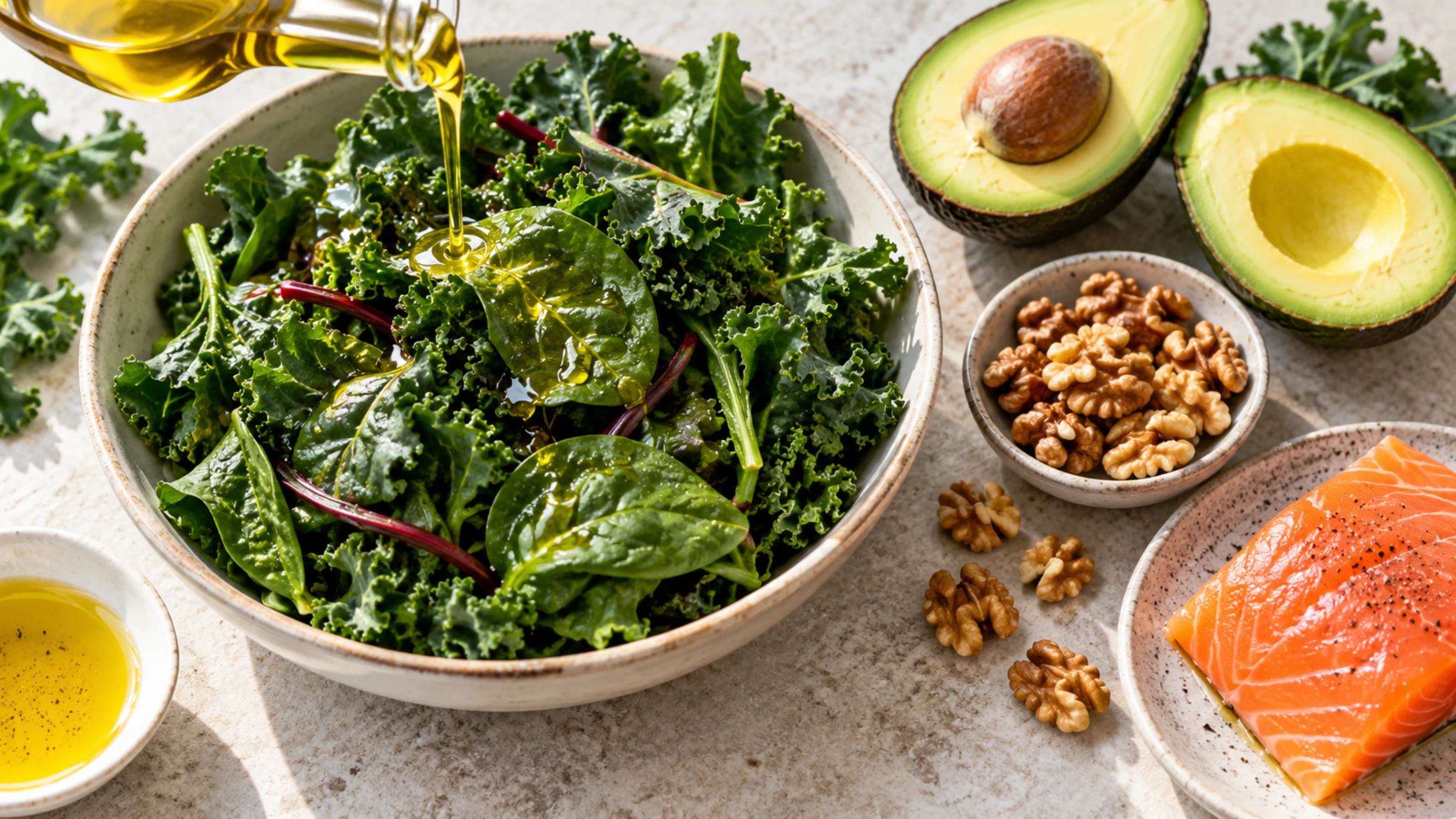
Vegetables eaten without fat remain nutritious. Your body absorbs their water-soluble vitamins and minerals, while dietary fiber provides vital digestive benefits in the gut without entering the bloodstream. However, certain fat-soluble nutrients depend on fat for solubility, including provitamin A carotenoids in carrots, vitamin K in dark greens, and vitamin E in seeds. Adding a modest amount of olive oil, avocado, or butter improves how efficiently your digestive tract absorbs these specific fat-soluble compounds.
The Three Fat Families
Most dietary fats are triglycerides: three fatty acid chains bound to a glycerol backbone. The arrangement of chemical bonds along these carbon chains governs how a fat behaves in cooking and in cells. Whole foods contain mixtures of fatty acids rather than single isolated types.
Saturated Fat
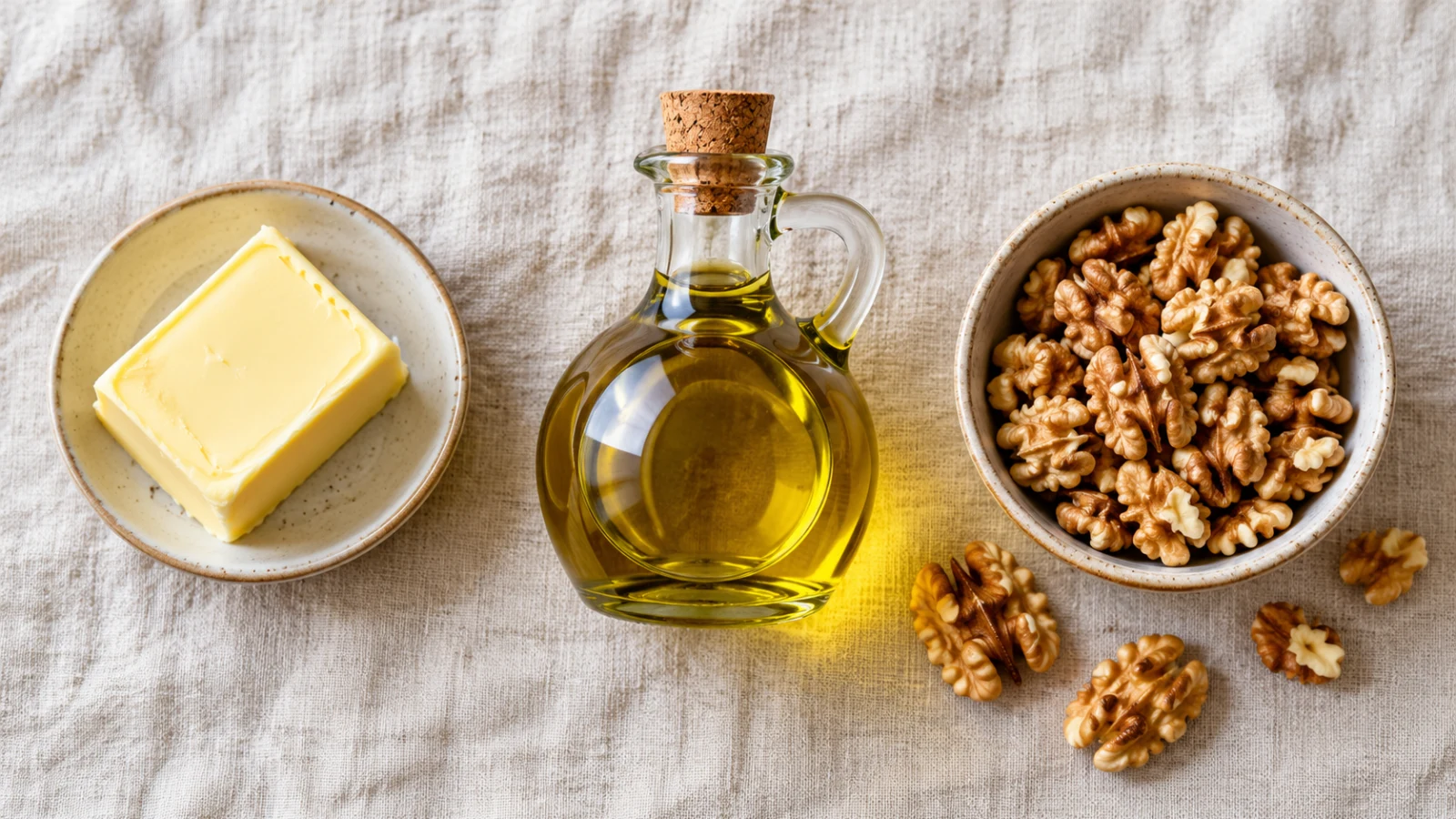
In a saturated fatty acid, the carbon atoms in the hydrocarbon chain are linked entirely by single bonds between carbon atoms, with each carbon carrying full hydrogen atoms, terminating in a carboxyl group. Because straight chains pack tightly, foods rich in saturated fatty acids tend to be solid or semi-solid at cool room temperature. Familiar sources include butter, cheese, tallow, and coconut oil. In tissues, saturated fatty acids lend structural stability to cell membranes.
Monounsaturated Fat
A monounsaturated fatty acid contains one double bond between carbon atoms. In whole foods, this bond almost always occurs in a cis configuration, introducing a bend that prevents tight packing. Consequently, monounsaturated-rich oils are typically liquid at room temperature and thicken or cloud when chilled. Oleic acid is a common monounsaturated fatty acid, found abundantly in olive oil, avocados, and almonds. In cell membranes, monounsaturated fats provide flexible structural support.
Polyunsaturated Fat
A polyunsaturated fatty acid contains two or more double bonds between carbon atoms. In cis configurations, these bends keep chains loose, so polyunsaturated oils generally remain fluid at cold temperatures. Because double bonds create sites susceptible to oxidation, these fats are more vulnerable to heat, light, and air. Polyunsaturated fats include two families your body cannot synthesize: omega-3 and omega-6 fatty acids.
Thermal Stability & Peroxidation Spectrum
Why heat tolerance depends entirely on the presence of unshielded double bonds
Saturated Fats
Tallow, butter, ghee, coconut oil. Packed tightly with no vulnerable double bonds to oxidize. Fully resilient to cooking heat without forming reactive aldehydes.
Monounsaturated Fats
Extra virgin olive oil, avocado oil, macadamia oil. Single double bond shielded by rich polyphenol matrices. Excellent for medium-heat sautéing and dressings.
Polyunsaturated Fats
Soybean, corn, canola, and unrefined fish oils. Multiple double bonds form conjugated dienes under frying heat, degrading into toxic lipid peroxides and 4-HNE.
Omega-3 and Omega-6 Fatty Acids
Humans lack enzymes to insert double bonds at the omega-3 and omega-6 positions. Both are essential fatty acids that must come from food:
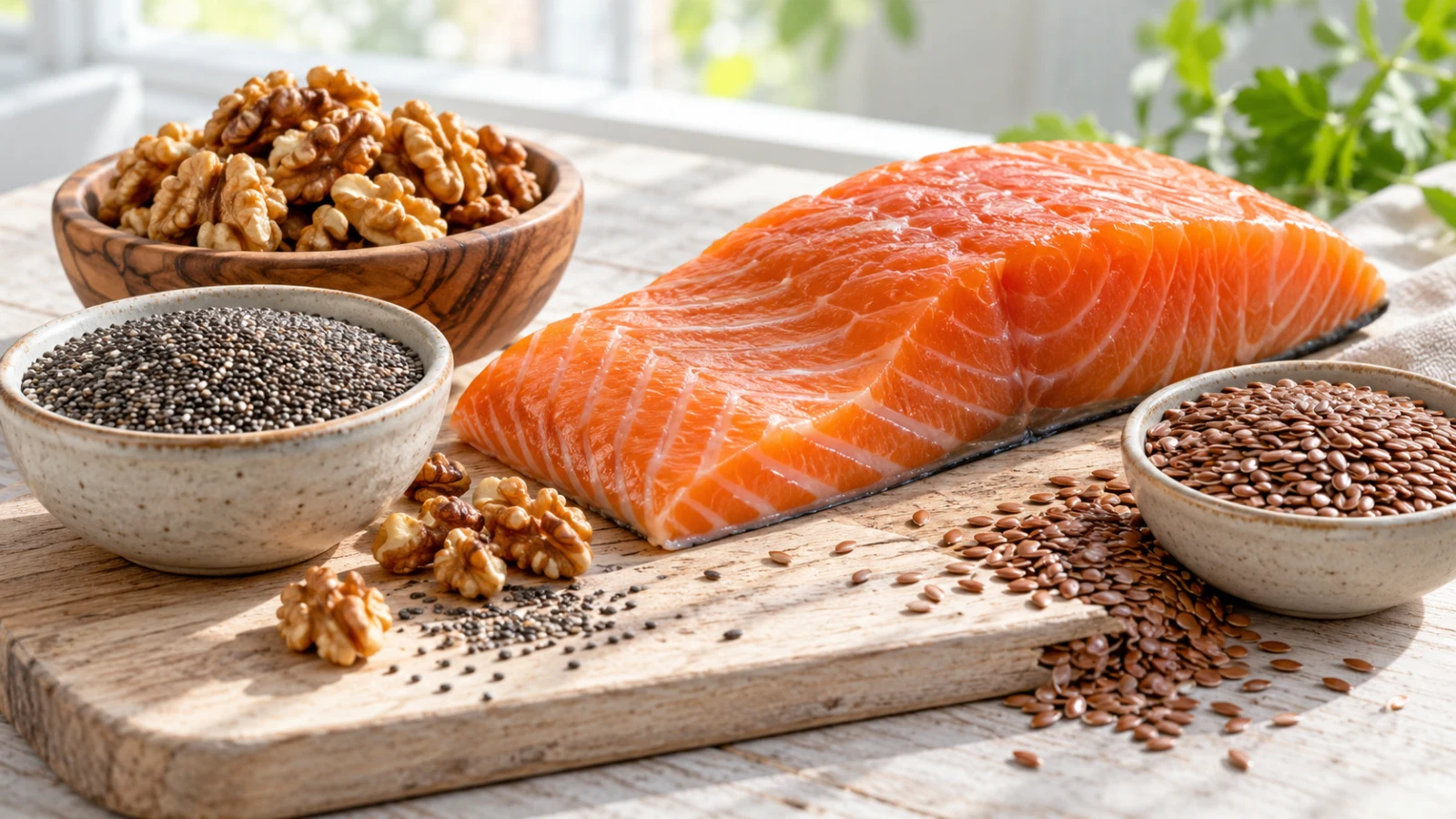
- Omega-3 fatty acids: The plant-derived parent is alpha-linolenic acid (ALA), found in walnuts, chia seeds, and flaxseed. Marine sources supply preformed long-chain omega-3s: eicosapentaenoic acid (EPA) and docosahexaenoic acid (DHA), found in oily fish like salmon and sardines. DHA concentrates structurally in brain tissue and retinal membranes, while EPA acts primarily as a precursor for signaling molecules. Both yield specialized pro-resolving mediators, though the specific clinical efficacy of dietary EPA versus DHA remains under active study. Enzymatic conversion of plant ALA to EPA and DHA is exceptionally low; thus, plant and marine sources provide distinct nutritional profiles rather than interchangeable functions.
- Omega-6 fatty acids: The parent compound is linoleic acid (LA), found in nuts, seeds, and oils like soybean, corn, and sunflower. Linoleic acid provides membrane structure and serves as a precursor for local signaling molecules that regulate blood clotting, vascular tone, and normal immune responses to injury.
Rather than an adversarial scoreboard where omega-6 drives harm and omega-3 stops it, both families coordinate normal immune activity and tissue repair.
Cooking Heat and Storage
How fats behave during cooking depends on fatty acid saturation, refinement, and non-fat solids, rather than chemical structure alone:
- Home Cooking: For stovetop cooking below roughly 375°F (190°C), monounsaturated-rich oils like extra-virgin olive oil and avocado oil perform reliably. Extra-virgin olive oil contains polyphenol antioxidants that may provide protective buffering against oxidation during normal cooking.
- Animal Fats: While saturated animal fats have heat-stable fatty acid chains, unclarified butter contains dairy proteins and sugars that scorch around 300°F to 350°F. For high-heat searing or roasting, clarified butter (ghee) or rendered tallow, which lack milk solids, perform more reliably.
- Prolonged Heat: Subjecting cooking oils to repeated or prolonged high temperatures accelerates the formation of oxidized breakdown compounds, including lipid peroxides and aldehydes, which are prudent to minimize.
- Storage: Store delicate, unrefined oils in tightly capped dark containers in a cool pantry away from stove heat and light to slow oxidation.
Cholesterol and Lipoprotein Transport
Dietary fat and cholesterol are chemically distinct. While dietary fats are predominantly triglycerides, cholesterol is a specialized steroid ring structure.
Because cholesterol and triglycerides cannot dissolve in water-based blood, the body packages them into spherical lipoproteins:
- Intestinal Pathway: Intestinal cells package absorbed dietary lipids into chylomicrons, which enter circulation via the lymphatic system to deliver fatty acids to tissues.
- Liver Remodeling Pathway: The liver secretes very-low-density lipoproteins (VLDL). As circulating enzymes strip triglycerides for energy, these particles undergo remodeling in the bloodstream, transforming into smaller, cholesterol-rich Low-Density Lipoproteins (LDL) that deliver cholesterol throughout the body.
- Reverse Transport: High-Density Lipoproteins (HDL), formed by the liver and intestines, collect surplus cholesterol from tissues and return it to the liver for excretion or reprocessing.
Atherosclerosis is an active biological disease rather than grease clogging a pipe. Circulating cholesterol-carrying particles, primarily LDL, cross into the arterial wall and become retained in the subendothelial space. Once retained, these particles undergo oxidative modification and provoke chronic local inflammation, driving foam cell formation and plaque growth over decades.
Clinically, LDL cholesterol (LDL-C) measures the mass of cholesterol carried in LDL, while LDL particle number (LDL-P) measures particle concentration. Elevated concentrations of circulating LDL particles are an established causal driver of cardiovascular disease. Saturated fat intake can increase circulating LDL in many individuals, though personal responses vary with genetics, metabolic health, and overall diet.
Atherosclerosis is an active biological disease rather than grease clogging a pipe.
What the Low-Fat Era Taught Us
In the late twentieth century, public health advice urged reducing total dietary fat to prevent cardiovascular disease and weight gain.
Food manufacturers responded by reformulating products into "low-fat" and "fat-free" versions. Because removing fat compromised flavor and texture, manufacturers added refined starches, maltodextrin, and sugar. While the percentage of calories from fat decreased in reported diets during this period, population rates of obesity and type 2 diabetes continued to rise.
The lesson is not that fat is harmless in any amount, nor that carbohydrates are inherently harmful. Rather, health outcomes depend on what replaces what.
Key idea
When saturated fats are replaced with refined starches and added sugars, markers of cardiovascular and metabolic risk do not improve and can worsen. Conversely, clinical trials show that replacing saturated fats with polyunsaturated and monounsaturated fats reliably lowers LDL particle concentrations and reduces cardiovascular events.
Checking Your Next Meal
Use three simple checks at your next meal:
- Pair fat with your vegetables: Add a drizzle of olive oil, a slice of avocado, or a knob of butter to vegetables and greens to enhance absorption of fat-soluble nutrients like provitamin A carotenoids and vitamin K.
- Anchor your intake in whole, predominantly unsaturated fats: Make extra-virgin olive oil, avocados, nuts, seeds, and fish your daily foundation, while enjoying butter, cheese, and meats in moderate culinary amounts.
- **
Incorporate distinct omega-3 sources across the week:** Because marine and plant omega-3s serve different roles and convert poorly, consume oily fish (such as salmon or sardines) twice weekly to supply preformed EPA and DHA, while regularly adding plant sources like walnuts, chia seeds, or ground flaxseed for essential ALA.
Educational content only. It is not individual medical advice.