Prerequisites
The Worn Path

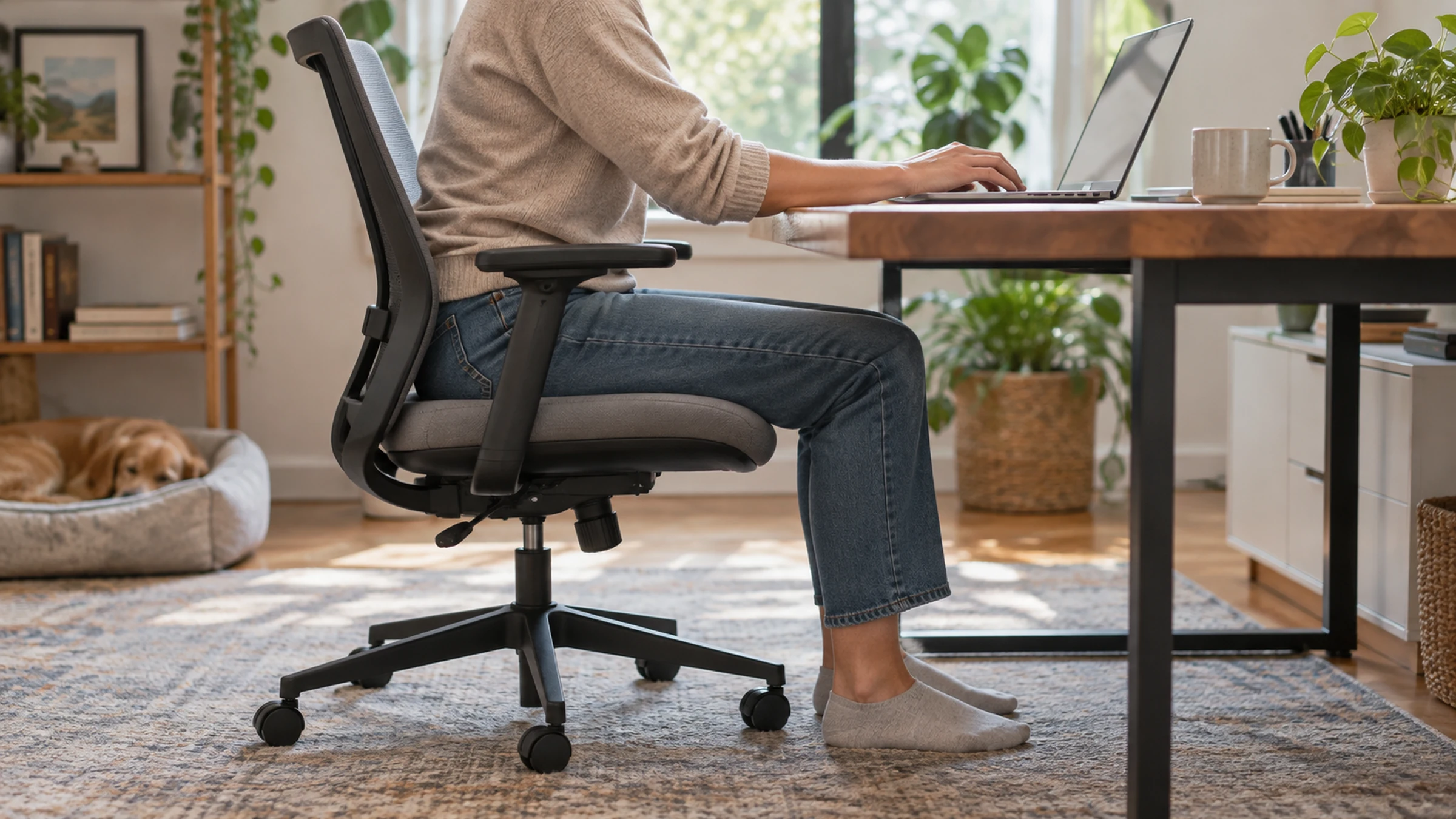
Eight hours in a chair is training. Your tissues simply do not call it that. Living tissue adapts to the position it holds most often, following the exact same stress, recovery, and adaptation loop from Guide 1 that adapts muscle to a heavy lift.
Posture is routinely framed as a discipline problem. People are told to sit up straight, pull their shoulders back, and hold that position by force of will. You might hold it for four minutes before your attention drifts and your body collapses back into the familiar slouch. The standard conclusion is that you lacked motivation.
That framing misses the mechanism. The body does not maintain resting posture through conscious choice. It holds the shape it has adapted to hold through thousands of hours of repetition.
Picture an open field of tall grass. The first time someone walks across it, the grass bends and springs back. But if that person walks the exact same line every day, the blades wear away, the soil compacts, and a visible dirt path appears. Repetition carved that path into the earth. Once it exists, your feet default to it automatically because it offers the least resistance.
Your posture is that field. Eight hours a day at a desk is the walking. Tissues adapt to the position they hold most. Hip flexors held short adapt toward stiffness. Upper back muscles held long adapt toward weakness. That is not a character flaw. It is simply the biological mechanism running on the physical inputs it receives.
Why Willpower Fails
Telling someone to fix their posture by remembering to sit up straight asks conscious willpower to override an adapted physical structure. That contest fails every time.
Conscious attention is a finite resource managed by your prefrontal cortex. Postural control is handled by automatic circuits in the nervous system that rely on resting muscle tone and connective tissue length. When you pull yourself upright, you use conscious effort to temporarily override an automated physical default.
The moment your focus returns to your actual work, conscious control disengages, and your body returns to the worn path. Willpower cannot run continuous interference for eight hours against tissues that have physically remodeled around a slouch. To change how you sit and stand, you have to change the physical path itself.
What Actually Adapts: The Desk Pattern
Spending long hours seated in front of a screen produces a predictable structural pattern. Clinicians sometimes call this upper-crossed posture, meaning a pattern where tight muscles and weak muscles cross each other diagonally across the upper body. The mechanism is simple: muscles held short adapt short and tight, while muscles held long adapt long and weak.
Across the front of your torso, the chest and front shoulder muscles spend all day in a compressed position while your hands rest on a keyboard. Over time, these tissues adapt toward tightness, losing passive flexibility.
Across your back, the opposite occurs. The muscles between your shoulder blades and along your upper spine spend the day held in a lengthened, rounded position. A muscle held long and passive receives no active tension signal. Without that stimulus, it adapts toward weakness.
Meanwhile, the neck undergoes its own distortion. The deep neck flexors are small, stabilizing muscles deep in the front of your throat that tuck the chin and keep the skull balanced over the cervical spine. When you lean toward a screen, these deep flexors go unused, and the head drifts forward.
This forward position alters leverage on your spine. When your head sits balanced directly over your torso, your skeleton bears its weight cleanly. As your head drifts forward, the lever arm lengthens, making the head feel substantially heavier to the muscles along the back of the neck and upper shoulders. Those muscles must contract continuously just to stop your head from falling forward.
- Chest and Front Shoulder: What adapts: short and tight from hours held together. What it needs: regular lengthening and position breaks.
- Upper Back and Shoulder Blades: What adapts: long and weak from constant passive stretch. What it needs: real active tension and strengthening.
- Deep Neck Muscles: What adapts: inactive while head drifts forward. What it needs: strength work to stabilize the skull.
- Hip Flexors and Psoas: What adapts: short and stiff from seated hip angles. What it needs: regular hip extension and active movement.
This pattern exposes the trap of stretching alone. When your upper back aches, the instinct is to stretch it. But those muscles are already over-lengthened and weak; stretching them further loosens an already unsupported frame. Conversely, stretching your tight chest muscles restores passive range, but without strengthening the weak upper back, nothing holds your shoulders in place. As noted in Guide 3 regarding the mobility and stability relationship, stretching loosens a stiff hinge, but you must strengthen the frame to keep it upright.
Viscoelastic Creep Hysteresis & Hydrostatic Disc Pressure
Ligaments and intervertebral discs are viscoelastic. Sustained low-load flexion causes mechanical "creep"—collagen fibers slowly stretch and lose recoil stiffness, creating an acute window of spinal instability that lasts for hours after standing.
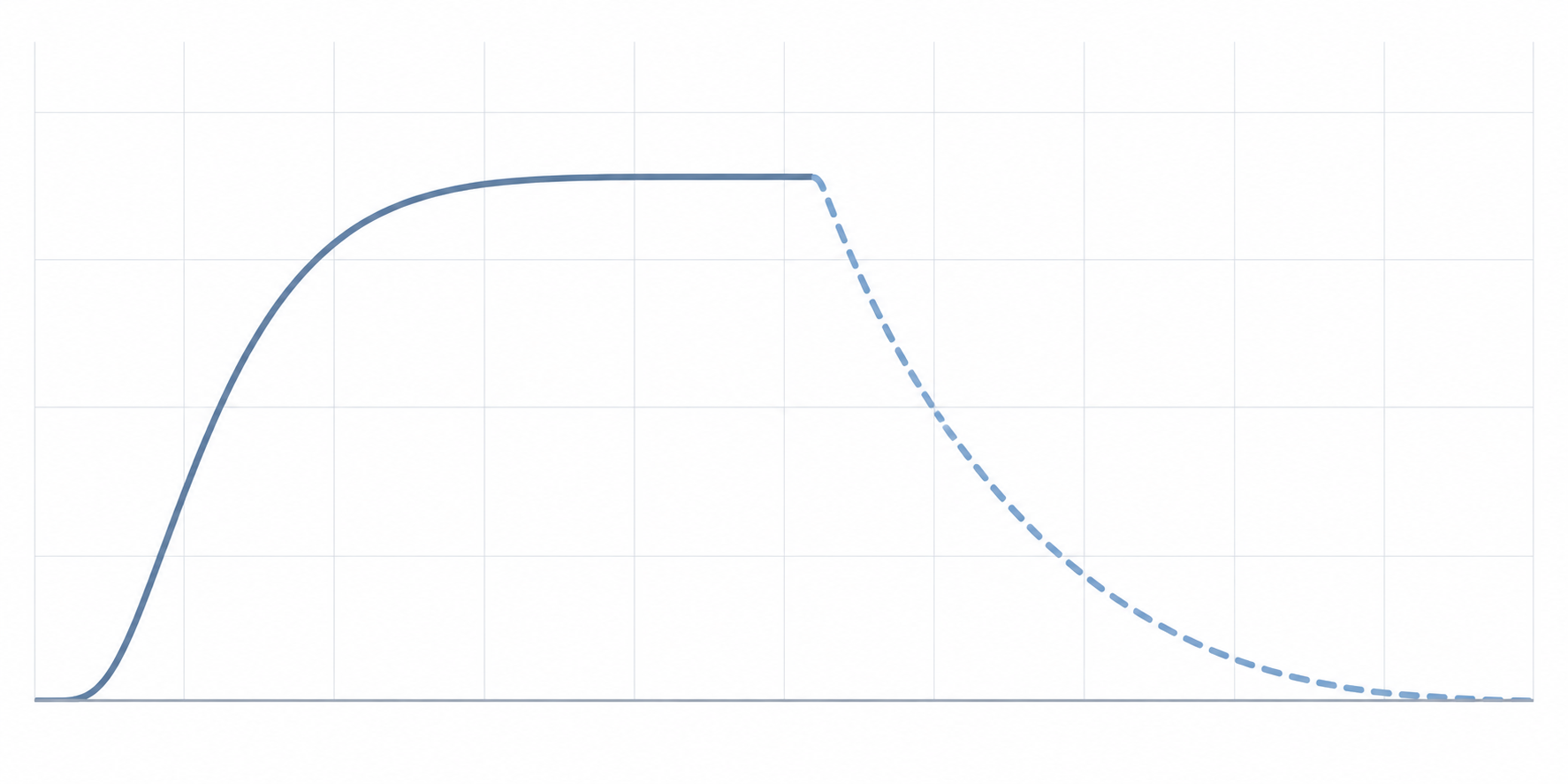
4h Post
Hysteresis Lag: Ligaments remain lax long after standing.
The Hips and Low Back
The lower half of your body follows the exact same adaptation.
To understand what happens below the waist, consider the hip flexors. The hip flexors are the group of muscles on the front of the pelvis and upper thigh that pull your knee toward your torso. Their primary muscle is the psoas. The psoas is a deep muscle running from your lower spine across the pelvis to attach to your thigh bone.
When you sit, your hips remain bent at ninety degrees. In this position, the psoas and surrounding hip flexors spend hours shortened. Over time, they adapt by becoming shorter and stiffer at rest.
When you stand up, you ask these shortened tissues to instantly lengthen so your pelvis can sit neutral. Because they are stiff, they pull forward on your lower spine and tilt your pelvis. That mechanical tension is a genuine contributor to the dull low-back ache many desk workers feel at the end of the day. Slumped sitting also places significantly higher passive load on the lumbar spine than upright standing, as relaxed trunk muscles transfer the job of supporting your torso entirely onto passive ligaments.
Separate this reality from the claim that sitting is the new smoking. Sitting is not a poison. The chair is not toxic. The actual problem is prolonged, uninterrupted static posture. If you stand rigidly at a standing desk for eight unbroken hours, you create the exact same issue in a different shape: pooling fluids, joint compression, and static tissue fatigue. Unbroken stillness is the stimulus that drives the adaptation, not the chair.
Janda's Crossed Syndromes: Neurological X-Patterns
Chronic desk posture is not simply tight muscles. By Sherrington's Law of Reciprocal Inhibition, hypertonic facilitated muscles fire constant Ia afferents that neurologically shut down and inhibit their antagonists.
Upper Crossed Syndrome (UCS)
Suboccipitals, Upper Trapezius, Levator Scapulae • Pectoralis Major & Minor.
Deep Cervical Spine Flexors (Longus Colli) • Lower Trapezius & Serratus Anterior.
Lower Crossed Syndrome (LCS)
Iliopsoas, Rectus Femoris, Tensor Fasciae Latae • Thoracolumbar Erector Spinae.
Gluteus Maximus, Gluteus Medius • Transverse Abdominis & Internal Obliques.
Unbroken stillness is the stimulus that drives the adaptation, not the chair.
The Fix Follows the Mechanism
Because posture is an adaptation, the fix follows the mechanism rather than willpower. You must change the physical inputs that created the default.
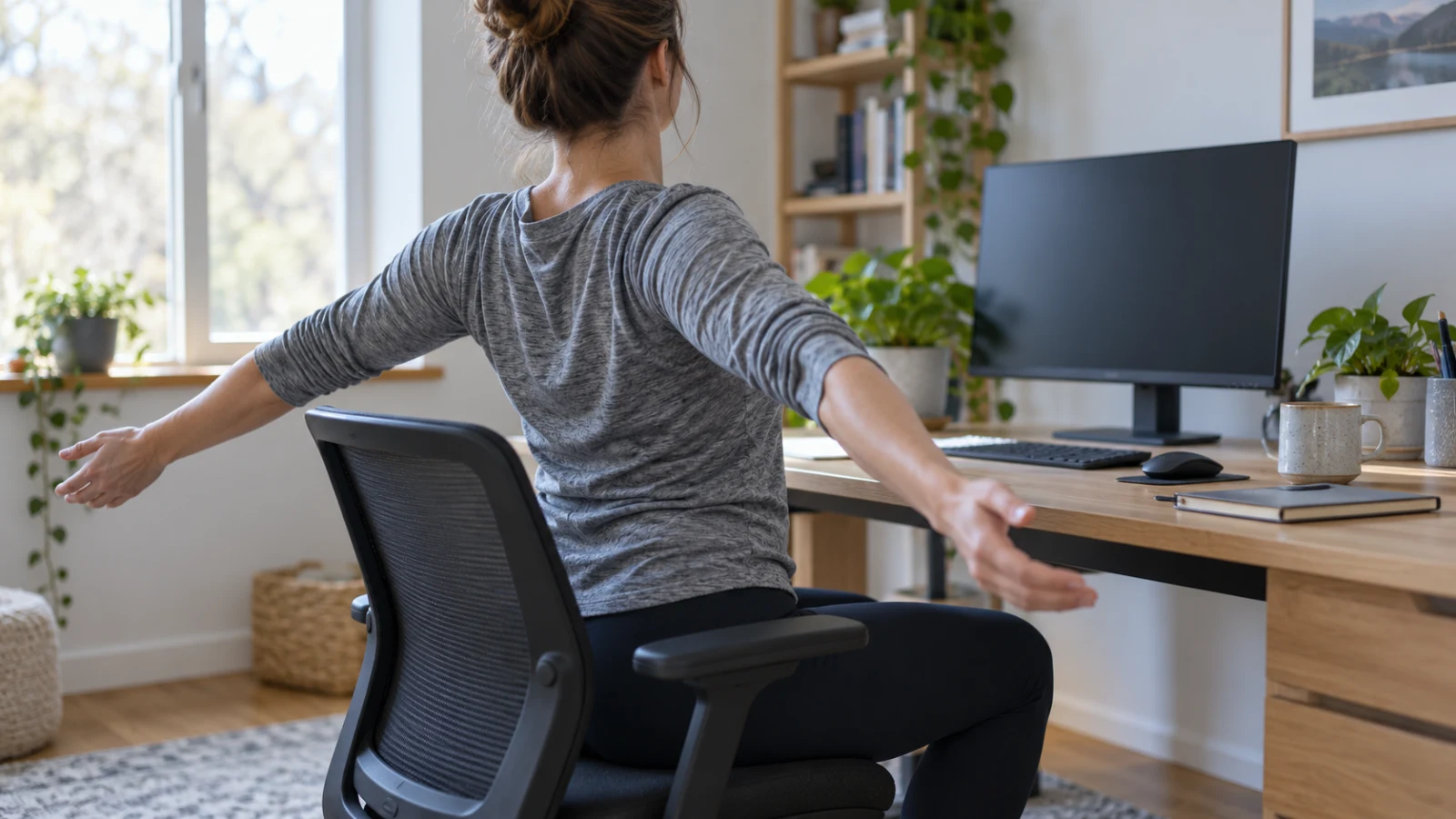
First, interrupt the position regularly. Tissues adapt to unbroken stillness. Standing up, walking, or changing your seated shape every thirty to forty-five minutes breaks the continuous signal that tells tissues to shorten.
Second, train the weak side with real, active tension. The upper back muscles and deep neck flexors became weak from underuse. You cannot fix that with a gentle stretch or a foam roller. Load those muscles with progressive resistance, such as rows and carries, to build the strength and resting tone that pull your frame upright naturally.
Third, actively lengthen the shortened side. Regularly open your hip flexors with lunges and stretch your chest muscles to restore their resting length, preventing them from pulling your frame back into the desk shape.
Key idea
Finally, stop pursuing a single correct posture. No tissue thrives in one unbroken shape, because living tissue continuously reshapes around whatever mechanical signal it gets most. The real goal is movement variability. Movement variability means having the capacity to shift comfortably through many different positions throughout the day rather than locking into just one. Sit upright for a while, lean back, stand, and move. The ideal posture is not a frozen position; it is continuous variation backed by balanced strength.
Posture and Pain
We must be honest about what posture can and cannot explain.
Postural adaptation is a genuine mechanical factor in daily discomfort. The tightness in your chest, the ache between your shoulder blades, and the pull across your lower back are explainable physical responses to sustained positions.
Yet posture is not a diagnosis. Plenty of people with textbook poor posture on an X-ray feel zero pain, while people with immaculate posture often suffer from severe discomfort. Pain is a complex neurological alarm influenced by stress, sleep, and overall load history, not just joint angles. Persistent or severe pain belongs with a qualified clinician who can evaluate your specific case, not with a lecture about sitting up straight.
The Field, Not the Lecture
Eight hours a day in one shape wears a path into your tissues the same way footsteps wear a path into an open field. The resulting slouch is not a moral failure or a collapse of willpower. It is simply the biological mechanism running: tissue reshaping structure to match daily mechanical demand, not a blueprint being executed.
You cannot defeat a worn path with discipline alone. To change the path, you must change the inputs. Break up the stillness throughout your day. Strengthen the muscles that have gone quiet, and lengthen the tissues that have grown tight.
Posture is the quiet adaptation running in the background of your working life. It reflects your load history, not your character.
Educational content only. It is not individual medical advice.