
Prerequisites
Most people assume training makes you fitter while you sweat. When asked where progress comes from, they point to the hardest effort: the final repetition in the squat rack, the lung-burning sprint, or the puddle on the floor. That view is intuitive, but it gets the physiology backward.
The workout does not build fitness. It only requests fitness.
In Guide 1, we introduced the movement loop: apply stress, recover, and adapt. In Guide 5, we examined the aerobic and anaerobic engines powering that effort. This guide crosses into the second half of the loop. Every hard workout creates a temporary deficit. Exercise micro-tears muscle fibers, depletes glycogen stores in your liver and muscles, and strains your central nervous system. When you leave the gym, you are temporarily weaker, slower, and less capable than when you arrived.
If the story ended there, exercise would simply be controlled damage. The gain happens only after training stops. Recovery is the biological work that converts that temporary deficit into lasting capability.
The Tide: Supercompensation, Visualized
To understand how training turns into progress, you need one foundational term: supercompensation. Supercompensation is the biological process in which the body rebounds from a temporary drop in performance by rebuilding itself beyond its starting baseline.
The clearest way to picture supercompensation is an ocean tide.
A hard training session pulls the tide out. The water retreats down the beach, leaving wet sand exposed. Inside your body, that receding water represents acute fatigue and microtrauma: frayed muscle fibers, depleted fuel tanks, and an exhausted nervous system. You sit below your normal baseline of function.
If you stop there, training is pure loss. But given proper recovery, the water does not simply return to where it started. The tide rolls back in and surges past the previous high-water mark, covering sand it could not reach before.
That overshoot is the adaptation. The newly reached sand is your new capability: stronger muscle fibers, expanded glycogen storage, and improved neural drive. That overshoot is supercompensation.
Without pulling the tide out, there is no signal for the water to return higher. This is why complete rest never builds fitness. But if you pull the tide back out while the water is still rushing up the beach, you interrupt the refill. Do that repeatedly, and you stay trapped at low tide: constantly exhausted, working hard, and wondering why your effort yields no results.
The Autonomic Recovery Seesaw & Vagal Tone
Recovery is not what happens when you lay on a couch. True recovery is an active neurological downshift commanded by the vagus nerve. If the sympathetic arm stays pinned down, biological supercompensation cannot ignite.
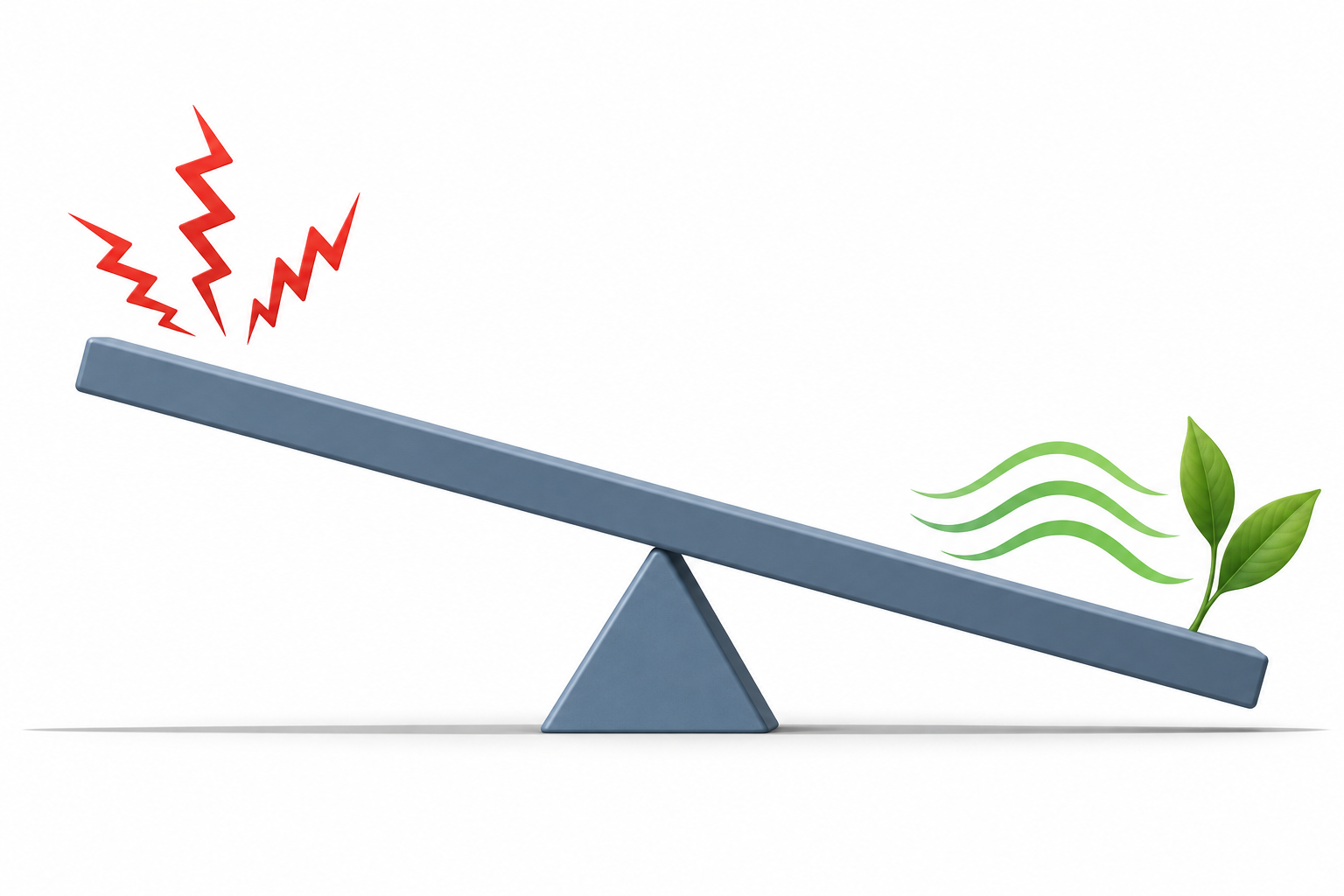
Sympathetic Activation
Drives acute adrenaline, elevated heart rate, and glycogen breakdown during the workout. If unmitigated at night, suppresses HRV and leaves muscle tissue in continuous protein catabolism.
Parasympathetic Vagal Shift
Releases acetylcholine, slows cardiac sinoatrial firing, and triggers protein synthesis and glycogen re-synthesis. Requires nasal breathing, sleep, and adequate caloric substrate.
What Recovery Actually Consists Of
Recovery is not passive relaxation. It is an active, energetically expensive sequence of biochemical processes running in parallel.
At the center of this rebuilding phase is muscle protein synthesis. Muscle protein synthesis is the biochemical process by which cells construct new structural proteins to repair and reinforce damaged muscle tissue.
Muscle protein synthesis and general recovery demand three strict inputs: sleep, nutrition, and time.
Sleep does the heaviest work. During slow-wave deep sleep, the pituitary gland releases its largest daily pulse of human growth hormone. This surge drives tissue repair and fuels muscle protein synthesis. Deep sleep is also when the central nervous system clears metabolic waste and resets. Cutting sleep short to fit another workout into your week cancels the night shift responsible for filling your order.
Nutrition provides the raw materials and the funding. Muscle protein synthesis cannot function without dietary amino acids from protein. Without them, the repair process lacks building blocks. Total calories matter equally. Repairing tissue and replenishing glycogen demands substantial energy. If you train intensely during an aggressive calorie deficit, the body defunds tissue repair to keep vital organs running. Training places the order; food delivers the materials.
Time cannot be compressed. Muscle protein synthesis remains elevated for roughly 24 to 48 hours after a demanding session. Ice baths, massage guns, and supplements cannot squeeze a 36-hour cellular rebuild into twelve hours.
Moreover, different tissues rebuild on radically different biological clocks. Skeletal muscle is vascular and rich in blood flow, repairing within days. Tendons, ligaments, and bones receive minimal blood flow, remodeling across a timeline of months. If your schedule only accounts for muscle recovery, your muscles may feel ready while your tendons slip steadily into structural debt. Rest days are structural requirements, not earned rewards.
- Sleep: Biological requirement: deep slow-wave sleep cycles. What happens if shortchanged: growth hormone drops and cellular tissue repair stalls.
- Nutrition: Biological requirement: adequate dietary protein and total calories. What happens if shortchanged: the body lacks amino acids and defunds structural repair.
- Time: Biological requirement: days for muscle tissue; months for connective tissue. What happens if shortchanged: the rebuild window shuts down before capacity exceeds baseline.
Multi-Tissue Remodeling Timelines & Tendon Desynchrony
Different tissues adapt to movement on radically different biological clocks. Blood and muscle adapt rapidly; dense, hypovascular tendons and cartilage take months to years to turnover collagen cross-links.
Highly vascularized. Myofibrillar protein synthesis peaks between 24–36 hours and fully remodels micro-damage within 48 to 72 hours.
Angiogenic sprouting triggered by VEGF shear signaling creates new capillary branches within two weeks of consistent aerobic dosing.
Osteoblastic bone deposition follows Frost's Mechanostat law; cortical bone density requires 3 to 6 months of repeated heavy axial compression.
The Tendinopathy Hazard: Bradytrophic collagen turnover is 4–5x slower than muscle. Athletes feel strong at week 6, ramp volume rapidly, and rupture tendons that have not yet cross-linked.
Active Recovery: Movement Without Stress

Recovery does not require staying completely motionless. This introduces another practical tool: active recovery. Active recovery refers to low-intensity, low-impact movement performed to promote blood flow without triggering new training fatigue.
A twenty-minute walk, an easy spin on a stationary bike, or a light mobility session gently elevates heart rate and circulation. That blood flow delivers oxygen and fresh nutrients to damaged muscle tissue while carrying away local metabolic byproducts.
Crucially, active recovery is optional, not mandatory. It is a support tool, not another workout. Some people recover faster with gentle daily movement; others benefit more from full physical rest. If an easy walk leaves you feeling loose and refreshed, use it. If it leaves you feeling drained or sore, it was not recovery.
Overreaching vs. Overtraining

To manage fatigue intelligently, exercise science separates accumulated strain into two distinct categories.
The first category is functional overreaching. Functional overreaching is a short, deliberate increase in training stress that temporarily reduces performance, followed immediately by targeted rest to induce a larger supercompensation rebound.
Coaches use functional overreaching intentionally. You might push your training volume or intensity beyond normal limits for seven to ten days, driving the tide far out. Then you initiate an intentional deload with several days of reduced work. Because the stimulus was high and the subsequent recovery was complete, the returning tide reaches higher than steady training alone could achieve. Functional overreaching is not a mistake; it is a planned tactic.
The second category is overtraining. Overtraining is a state of chronic systemic exhaustion caused by a long-term imbalance between training stress and recovery, resulting in sustained performance drops.
In overtraining, the tide is dragged back out repeatedly before it can ever reach the shore. The deficit compounds across weeks or months. The warning signs appear gradually as an interrelated pattern:
- Performance stalls or declines despite high effort.
- Morning resting heart rate creeps upward over weeks.
- Sleep quality degrades, leaving you unrefreshed despite exhaustion.
- Motivation to train flattens into persistent apathy.
- Lingering joint aches and minor illnesses become frequent.
Do not view this list as a simple checklist where two symptoms prove a clinical diagnosis. It is a pattern. When several markers trend negatively together for weeks, your recovery has collapsed.
The remedy for overtraining is simple and non-negotiable: reduce training stress long enough for recovery to finish. No supplement or treatment can replace rest. You cannot train your way out of a recovery deficit.
When Rest Days Feel Unproductive
For motivated people, a scheduled rest day can trigger real anxiety. When you define dedication by physical effort, resting feels dangerously like falling behind.
That discomfort stems from a fundamental misunderstanding. It assumes that physical exertion is the only productive phase of training.
A rest day is not an interruption of your progress. It is the specific window where the progress is manufactured. Skipping a rest day out of guilt does not prove superior discipline. It halts construction mid-build, restarts demolition, and mistakes exhaustion for achievement.
Key idea
That quiet Tuesday on the couch is often the only day of your week that actually raises your physical ceiling. The workout filed the request. The rest day delivers the result.
Let the Tide Come Back Past the Mark
Physical progress follows an unyielding biological sequence:
- Training pulls the tide out, creating a targeted, temporary deficit.
- Sleep, nutrition, and time allow the tide to roll back in.
- The surge past the old high-water mark is supercompensation: the only phase that delivers lasting capability.
If you cut recovery short, the tide never reaches the shore. It gets dragged immediately back out, keeping your body permanently below baseline.
Train with intent when it is time to work. Then step back, supply the raw materials, and let the tide come all the way back past the mark.
Train with intent when it is time to work. Then step back, supply the raw materials, and let the tide come all the way back past the mark.
Educational content only. It is not individual medical advice.