
Prerequisites
The bar is back on the rack. Your breathing is heavy and your shirt is soaked, but nothing on you is stronger yet.
At this moment, you have not built new tissue or upgraded your capacity. You filed a work order: how much force was needed, how long it had to be sustained, and which muscles had to deliver it. The crew that builds your strength arrives only after you leave the gym.
Many lifters treat training like punishment: grind until it burns, wake up sore, and treat that ache as proof the workout worked. The slogan "no pain, no gain" assumes muscle only grows when forced to suffer. That assumption is false. Soreness is an occasional side effect of training, not the trigger for progress. Many of your most productive workouts will not leave you sore at all.
A heavy set is a work order, not an act of destruction:
- Weight tells your body how much mechanical tension the muscle must produce next time.
- Repetitions tell your body how long that tension must be sustained.
- Exercise selection tells your body precisely where to send the repair crew.
Submit the same work order with the same weight every week, and your body completes the job and stops building. That is not stubbornness. That is a completed project.
What a Muscle Fiber Actually Is
A muscle fiber is an individual muscle cell shaped like a long, thin cylinder. Muscles are not solid blocks of tissue; they are bundles of thousands of individual muscle fibers wrapped in connective tissue.
Inside each fiber run microscopic strands called myofibrils, which contain two primary contractile proteins: actin and myosin. When your brain signals a muscle to contract, reaching heads on the thick myosin filaments latch onto thin actin filaments and pull inward, sliding past each other to shorten the fiber and produce force.
Henneman's Size Principle Recruitment Ladder
You cannot choose to recruit high-threshold Type IIx muscle fibers first. The central nervous system obeys an unyielding mathematical law: small motor neurons depolarize at low voltage; giant motor units fire only when loads crush or fatigue exhausts the base.
How Your Body Recruits Muscle

Prime movers in the squat
Your body never fires every fiber at once. Inside every working muscle it recruits the same way: small endurance units switch on first, even on light sets; mid-size units join as the effort climbs; and the big reserve fibers come last, only at heavy or near-failure effort. The letters below mark the three prime movers in this lift. They are not an order the muscles fire in.
- QQuadriceps — Front of the thigh; straightens the knee out of the bottom.
- GGlutes — Hips; drive the standing phase.
- EErectors — Spinal muscles; hold the torso braced and upright.
Your body does not activate every fiber in a muscle at once. It uses recruitment.
Recruitment is the process by which your central nervous system activates specific muscle fibers to meet physical demand. For light tasks, like picking up a cup, your nervous system recruits only a tiny fraction of fibers: smaller, endurance-oriented units that can work all day without tiring.
As demand climbs, your nervous system recruits progressively larger, stronger fibers held in reserve. These reserve fibers produce massive force, but tire quickly, so your body deploys them only when forced.
This explains why heavy weights and hard sets build strength. Heavy weight forces your nervous system to call up those reserve fibers immediately. Lighter weights can reach those same reserve fibers, but only if you take the set close to muscular fatigue, forcing the reserve crew to step in as smaller fibers give out. Either way, the signal only reaches the fibers you actually recruit.
During your first few weeks of training, rapid strength gains come primarily from your nerves, not larger muscles. Your nervous system simply gets better at firing the right fibers in the right sequence. The gym filed the order, but the body's first delivery was upgraded wiring rather than thicker tissue.
Tension: The Primary Signal
Once fibers are recruited, they must experience tension.
Tension is the mechanical pulling force that a muscle fiber experiences and generates when working against resistance. Tension is the primary language muscle understands. When actin and myosin strain against heavy resistance, that physical pull triggers chemical pathways telling the cell to grow.
Metabolic stress and minor tissue damage play smaller supporting roles, but mechanical tension does almost all the talking. Fatigue without mechanical tension is just sweat: an hour of frantic calisthenics leaves you exhausted without building much strength.
The Sarcomere Length-Tension Barometer
Muscle force is not generated by magic; it is generated by physical globular myosin heads grabbing binding sites on thin actin filaments. The force a muscle produces depends strictly on sarcomere operating length.
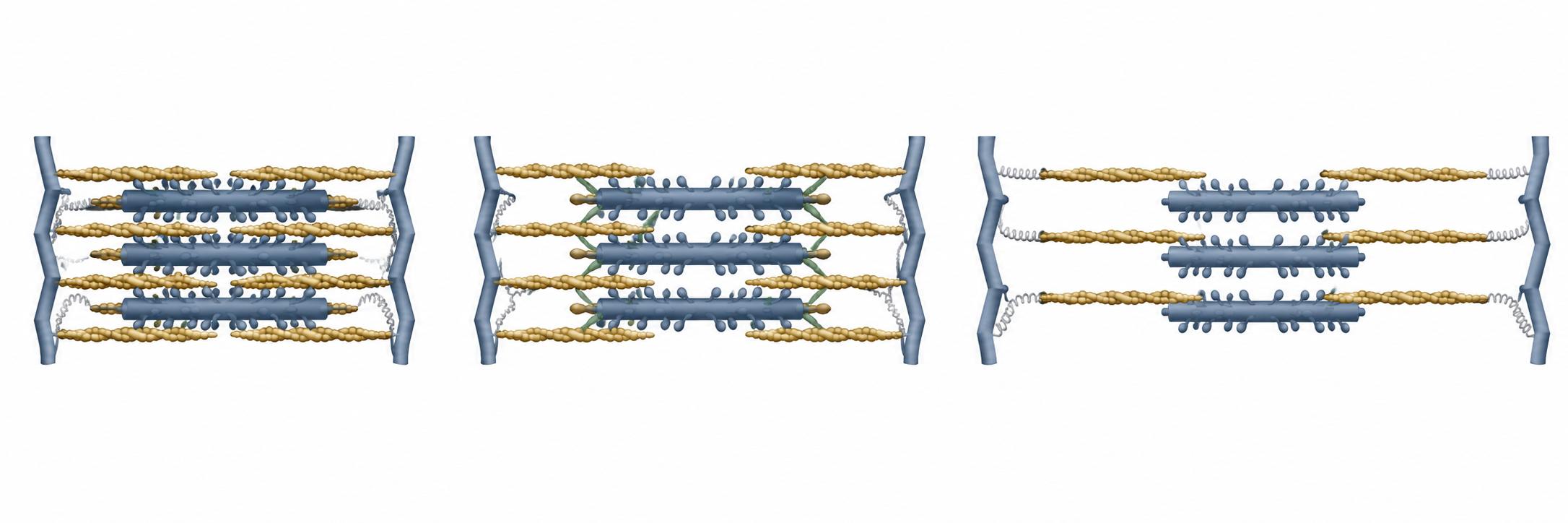
Active Insufficiency (<1.8μm)
Actin filaments collide at the bare zone. Myosin heads cannot form clean cross-bridges. Tension capacity collapses to ~40%.
Maximal Tension (2.0–2.2μm)
100% of myosin heads bind to actin. Maximum isometric cross-bridge cycling force generated.
Passive Titin Strain (>2.6μm)
Active cross-bridges decrease, but titin molecular springs unfurl, creating massive passive tension that signals longitudinal hypertrophy.
Tension is the primary language muscle understands.
The Three Ways a Muscle Produces Tension
Tension occurs whenever a muscle works, not just when lifting upward. A muscle produces tension in three distinct states: concentric, eccentric, and isometric.
A concentric contraction occurs when a muscle shortens while producing force (such as standing up from a squat or pulling up during a chin-up).
An eccentric contraction occurs when a muscle lengthens while resisting force, acting like an active brake (such as lowering under control into a squat or descending from a chin-up).
An isometric contraction occurs when a muscle produces force without changing length (such as holding a plank or carrying a heavy suitcase at your side).
- Concentric: Muscle action: shortens under load. Everyday example: standing up from a low chair.
- Eccentric: Muscle action: lengthens under load. Everyday example: lowering a heavy box to the floor.
- Isometric: Muscle action: holds constant length. Everyday example: carrying grocery bags at your sides.
The eccentric phase deserves special attention because lifters routinely rush through it, letting gravity drop the weight. Dropping a weight without control throws away half the work.
Your muscles can produce significantly more force while lengthening than while shortening. Lowering a weight under control places high mechanical tension on fibers while they stretch, triggering a strong remodeling signal. The descent is not a rest between reps; it is half the work order.
The Repair Loop in Muscle Tissue
This process directly reflects the stress, recovery, adaptation loop introduced in Guide 1.
Heavy mechanical tension, especially during controlled eccentric lowering, causes microscopic tears in muscle fibers. This micro-trauma is not an injury; it is the physical signal that opens the job site.
Your body responds with localized inflammation to clear out damaged cellular debris. Once the site is clean, specialized repair cells activate to rebuild the fiber.
Given adequate protein and recovery time, your body does not merely patch the tear to its previous size. It adds new strands of actin and myosin, rebuilding the fiber slightly thicker and stronger so it can handle that load next time without tearing.
This rebuilding process is driven by muscle protein synthesis. Muscle protein synthesis is the biological mechanism by which cells build new proteins to repair and enlarge muscle tissue. Following a challenging workout, muscle protein synthesis remains elevated for roughly 24 to 72 hours.
This 24 to 72 hour window explains why training the same muscle group to failure every day backfires. When you train a muscle before it finishes rebuilding, you disrupt the crew before the concrete sets. Training each muscle group hard two or three times a week works better because it allows the construction window to close.
Key idea
The gym files the order. Food supplies the materials, and sleep provides the shift where the crew works. If you train hard but skimp on protein or sleep four hours a night, you submit an urgent order while locking the supply gate.
Progressive Overload: Updating the Order

One lift, eight weeks, three ways to raise the demand
- Week 1
3 × 8 · 135 lb
Baseline. The order your body has already built for.
- Week 4
3 × 8 · 140 lb
Plus 5 lb on the bar for the same reps and sets.
- Week 8
4 × 8 · 145 lb
Plus 5 lb again, and one more set of total work.
Same movement, rising demand. Add a little weight, a rep, a set, a slower descent, or more range, then let the tissue catch up.
Once your body finishes repairing a muscle fiber, that specific work order is complete.
If you return to the gym next month and lift the same weight for the same repetitions, your body has no biological reason to grow. The existing structure already handles that demand.
To keep building strength, you must practice progressive overload. Progressive overload is the gradual increase of mechanical stress placed on the body over time.
Progressive overload does not mean adding weight to the bar every single session; human biology does not adapt in an unbroken straight line. You can update the order in several ways:
- Lift slightly more weight for the same repetitions.
- Perform an additional repetition with the same weight.
- Add another set to increase total workload.
- Slow down the eccentric lowering for greater control.
- Increase your range of motion.
The rule is simple: the new order must demand slightly more than what was previously built, or the crew has nothing new to do. Lifting the exact same weights with the same effort year after year will maintain your current tissue, but it will never build a new floor.
Why Soreness Is an Unreliable Signal
Because the repair loop involves micro-tears and inflammation, people frequently confuse soreness with progress.
Delayed-onset muscle soreness, commonly abbreviated as DOMS, is the muscle tenderness, stiffness, and dull ache that emerges 24 to 48 hours after unaccustomed or strenuous exercise.
DOMS is a real biological event, but it is an unreliable gauge of how much strength you built. Soreness is triggered primarily by novel movement patterns and unfamiliar eccentric stretching, not by raw adaptation.
If you hike down a steep mountain trail or try an unfamiliar sport, you will wake up intensely sore two days later. That does not mean you built significant strength. It means your nervous system used an unfamiliar coordination pattern, creating awkward mechanical strain.
Conversely, an experienced lifter can complete a demanding squat session, achieve clear progressive overload, and wake up the next morning feeling zero soreness. Their body is adapted to that movement pattern, so inflammation remains muted. The work order was received and construction will proceed, even though the job site produced almost no dust.
Chasing soreness encourages bad habits, like switching exercises constantly just to hurt, or training past the point of recovery. Soreness tells you that tissue experienced novel strain, not that your workout was productive.
The Work Order Summary
Keep the construction site analogy clear whenever you train:
- Tension, reps, and exercise choice are the specifications: they tell your cells how much force to produce, for how long, and in which muscles.
- Microscopic tears open the site: they clear out worn structures so repair cells can rebuild the fiber thicker.
- The 24 to 72 hour recovery window is the construction shift: muscle protein synthesis uses food and rest to add new tissue.
- Progressive overload updates the contract: it demands slightly more than before so the crew has a reason to return.
- Soreness is job site dust: a byproduct of unfamiliar strain, not proof that the building grew.
Strength does not happen while your hands are on the bar. The gym is only where you file the paperwork. Construction happens after you walk out the door.
Educational content only. It is not individual medical advice.