
Prerequisites
The Biological Bottom Line
A peptide does nothing on its own. It is an encrypted key that must fit a specific receptor lock on the cell membrane to turn over the engine.
How tightly a key fits the lock (Kd) does not tell you how hard the lock turns. High affinity with zero efficacy is a receptor blocker.
Blasting massive doses of peptides continuously doesn't accelerate healing; it causes receptor internalization, beta-arrestin desensitization, and complete signaling tolerance.
Human biology operates in rhythmic pulses. Giving intermittent, pulsatile signals lets cell receptors reset and resensitize for the next wave.
The vial on the counter cannot weave collagen, fill a tear, or decide which way a new fiber should face. It cannot grow a capillary with a plunger.
To understand what a peptide actually does, you must define the physical terms of cellular communication:
A signal is a chemical message traveling through the body to prompt a living cell to act.
The extracellular space is the fluid environment outside the cell where these messages circulate.
The membrane is the fatty outer wall enclosing every cell, separating outside fluid from internal machinery.
A receptor is a protein embedded in the membrane, shaped like a lock to recognize a specific incoming knock.
Binding is the physical event where the signal docks into that matching receptor.
A peptide is an extracellular signal: a short chain of amino acids floating outside the cell. When it arrives, it does not enter the room or pick up tools. It delivers an instruction at the membrane.
Marketing routinely sells a fantasy. Promoters describe repair peptides like BPC-157 as a miniature construction crew patching tissue, while describing metabolic peptides like semaglutide as dissolving fat on contact. Both stories make the same mistake: they credit the synthetic molecule and ignore the living cell. A molecule cannot repair tissue on its own. It is a knock at the door. The cell on the other side does the work.
The Three Links of Cellular Action

Biological communication requires three unbroken links:
- Signal: The molecular knock carrying an instruction through extracellular fluid.
- Receptor: The membrane protein shaped to recognize that specific knock.
- Response: The cellular labor of burning fuel, using raw materials, and assembling tissue.
Break any link and the outcome is zero. The molecule can be real, the dose exact, and the tissue unchanged.
The Knock Is Not the Crew
Think of the cell as a working room and the peptide as a knock at the door.
The knock is physically real, with a definite molecular shape and mass in extracellular fluid. But knocking on a door does not rebuild the room behind it. The knock does not clear debris, carry lumber, or hang drywall. It is an external prompt.
For extracellular peptides, the molecule does not cross the membrane to take charge. It delivers an instruction from the outside. Information is not building material. Knowing a wall must be built is useless if nobody inside the room picks up the bricks.
This is why the same compound can be a revelation in one context and a non-event in another. The knock arrived both times. But in the second case, the door was wrong, closed, or the room was out of supplies. Blaming the peptide for failing, or crediting the vial for a repair the cell executed, is the same category error. The signal is just the prompt. The outcome depends entirely on what happens inside the room.
The 7-Transmembrane GPCR Signaling Cascade
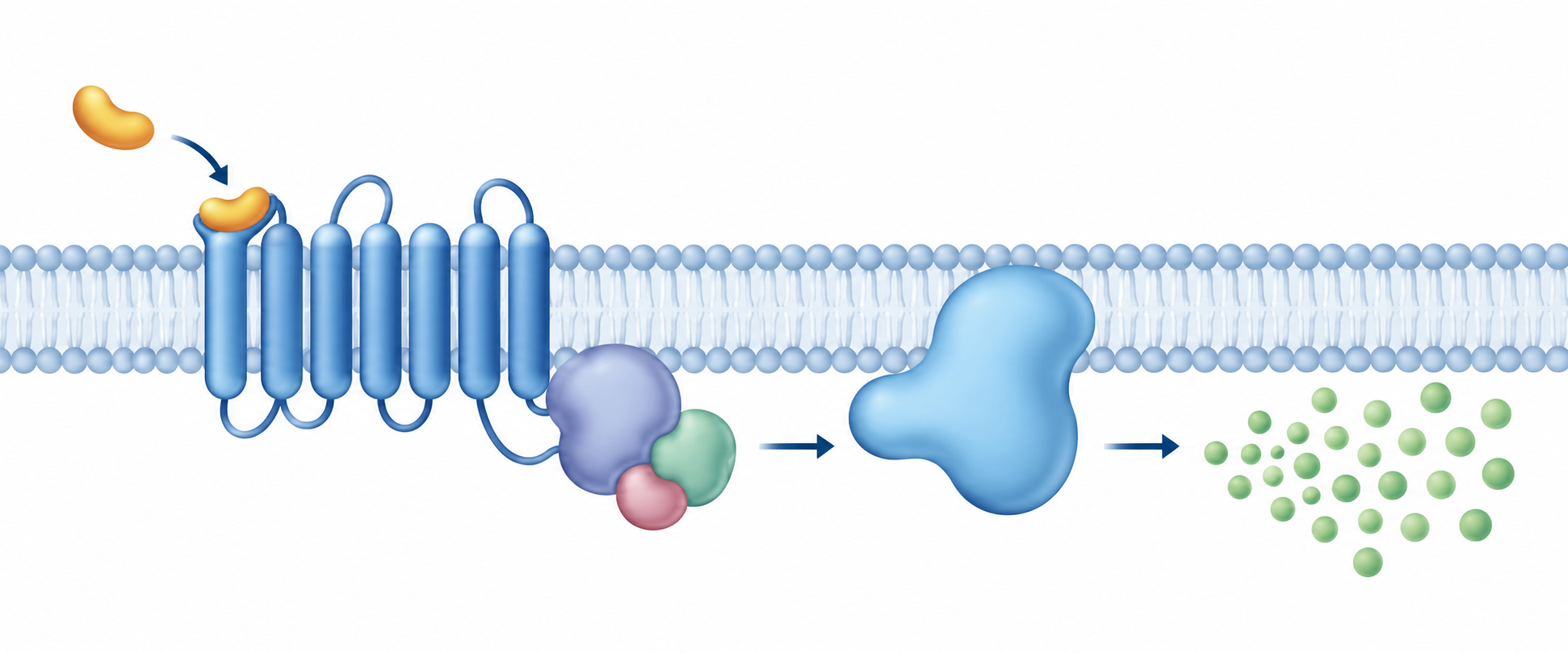
- SIGNAL — orange shape at the far left, above the membrane.
- EXTRACELLULAR DOMAIN // LIGAND BINDING CLEFT — orange ligand seated at the top of the receptor, left of center.
- HYDROPHOBIC CORE // PHOSPHOLIPID BILAYER — pale-blue horizontal membrane crossed by the blue seven-helix bundle.
- CYTOPLASMIC DOMAIN // G-PROTEIN COUPLING & SECOND MESSENGERS — area below the membrane, extending toward the right-hand relay.
- Gα — purple part of the three-part complex just below the receptor.
- Gβγ — adjacent green and red parts of that complex.
- ADENYLATE CYCLASE — large blue shape at center-right.
- → cAMP • PKA Amplification — green messenger dots at the far right.
Peptide docks into specific extracellular loop residues.
Helical bundle pivots, releasing GDP to bind GTP on G-alpha.
cAMP or IP3/DAG cascades amplify the signal by 10,000x.
The Receptor Has to Recognize the Knock

A cell must register the knock before internal work begins. That requires a matching receptor embedded in the membrane, facing outward into the fluid.
When binding occurs, the receptor shifts shape. That shift is the exact moment an external event becomes an internal instruction.
Without a matching receptor, the knock is silent. A repair peptide washes past red blood cells, fat cells, or uninjured tendon cells without triggering a reaction. If a cell lacks the reader, the signal is invisible.
This requirement ruins the fantasy of universal healing injections. Specificity rules biology. Different tissues hang different doors. A liver cell does not present the same receptors as a tendon cell. A repair peptide and a satiety peptide are different knocks at different doors, not interchangeable healing liquids.
Tissue state matters as much as tissue type. As established in Guide 3, tissue healing begins with an inflammatory cleanup phase before rebuilding starts. An inflamed, scarred, or starved cell displays a different set of surface doors than a rested, nourished cell. Sometimes a cell will not present the door until the local environment is ready for construction.
Furthermore, not every marketed peptide has a fully mapped human receptor. BPC-157, for example, is widely promoted for repair, yet its specific cell-surface receptor in human tissue remains unconfirmed in clinical pharmacology. A named sequence is not a confirmed conversation. Without a matching door, the knock has nowhere to land.
The Cell Does the Work
When a signal binds its receptor, the cell adjusts its machinery: altering protein output, signaling capillaries, or shifting inflammatory tone.
The peptide did not weave collagen. The living cell manufactured it, burning its own energy, activating its own pathways, and assembling the protein.
This requires substrate. Substrate is the biological term for the raw physical materials, such as amino acids and minerals, needed to construct tissue.
A matching receptor is necessary, but never sufficient. Deliver a clear signal to a receptive cell, and it still cannot build without substrate. An undernourished body receives the instruction to build a wall without the bricks.
Mechanical load is just as vital. When a tendon cell makes collagen, chemical signals cannot tell fibers which way to align. Movement and tension provide the mechanical load that directs new fibers to face the line of force. Without load, new collagen forms a disorganized, fragile mesh.
Key idea
The signal requests the work. Substrate provides the bricks. Load provides the blueprint. Missing any of them stalls the build.
Pulsatile Precision vs. Continuous Saturation
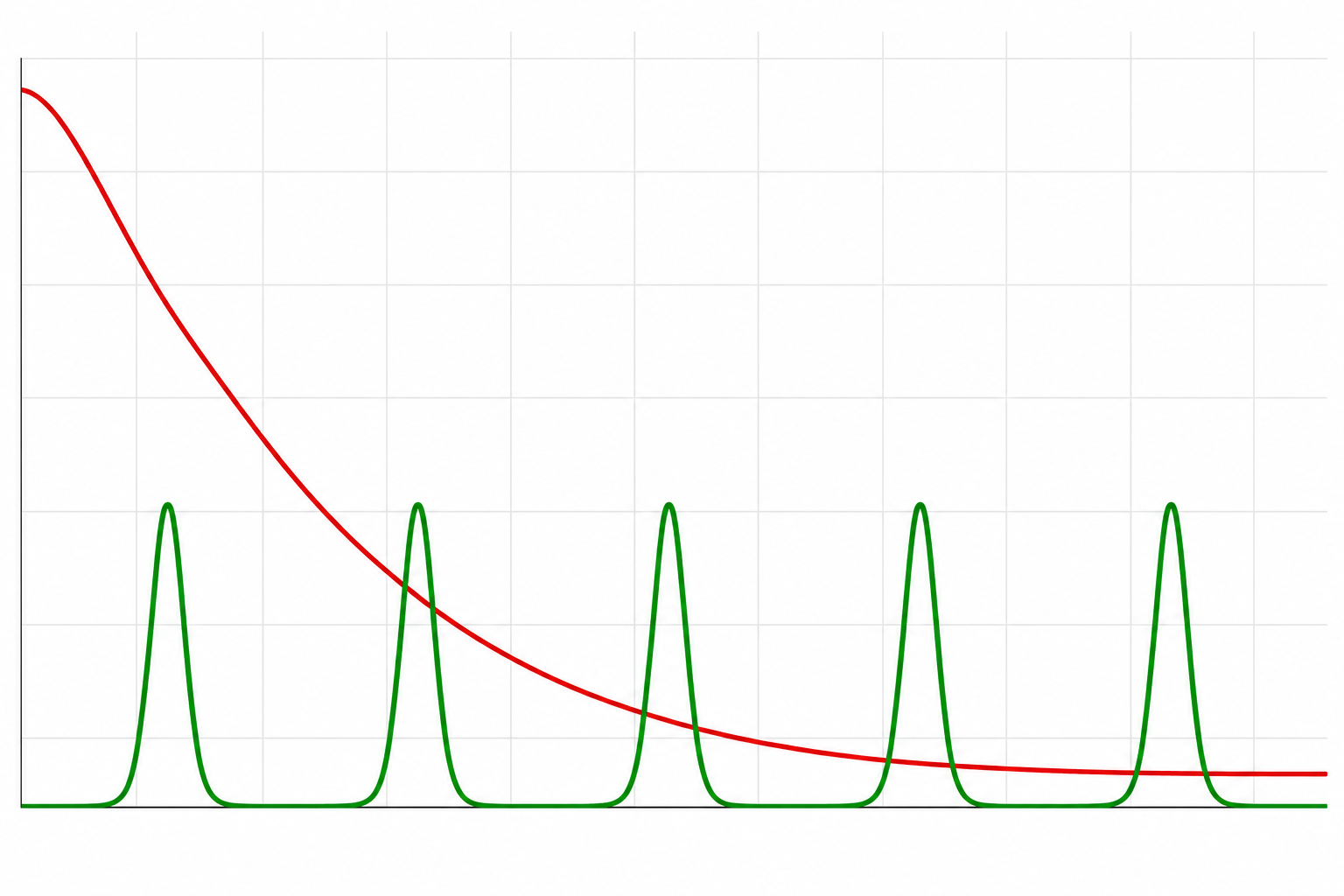
When a cell surface receptor is continuously bombarded with high-dose ligand, G-protein coupled receptor kinases (GRKs) phosphorylate the receptor's intracellular tail. This recruits beta-arrestin, which physically uncouples the receptor from its G-protein and triggers clathrin-mediated endocytosis, pulling the receptor inside the cell where it cannot be reached.
Binding Affinity ($K_d$)
The Grip. The dissociation constant represents how tightly the peptide key clicks into the receptor cleft. Lower numerical Kd means tighter binding and higher nanomolar potency.
Intrinsic Efficacy
The Spark. Once docked, does the peptide actually rotate the helical bundle to trigger the downstream intracellular cascade? A full agonist turns it 100%; an antagonist turns it 0%.
Internalization & Reset
The Self-Defense. Sustained exposure causes the cell to pull the receptor lock indoors via endocytosis. Pulsed rest windows are mandatory for receptors to recycle back to the cell surface.
More Signal Is Not More Repair
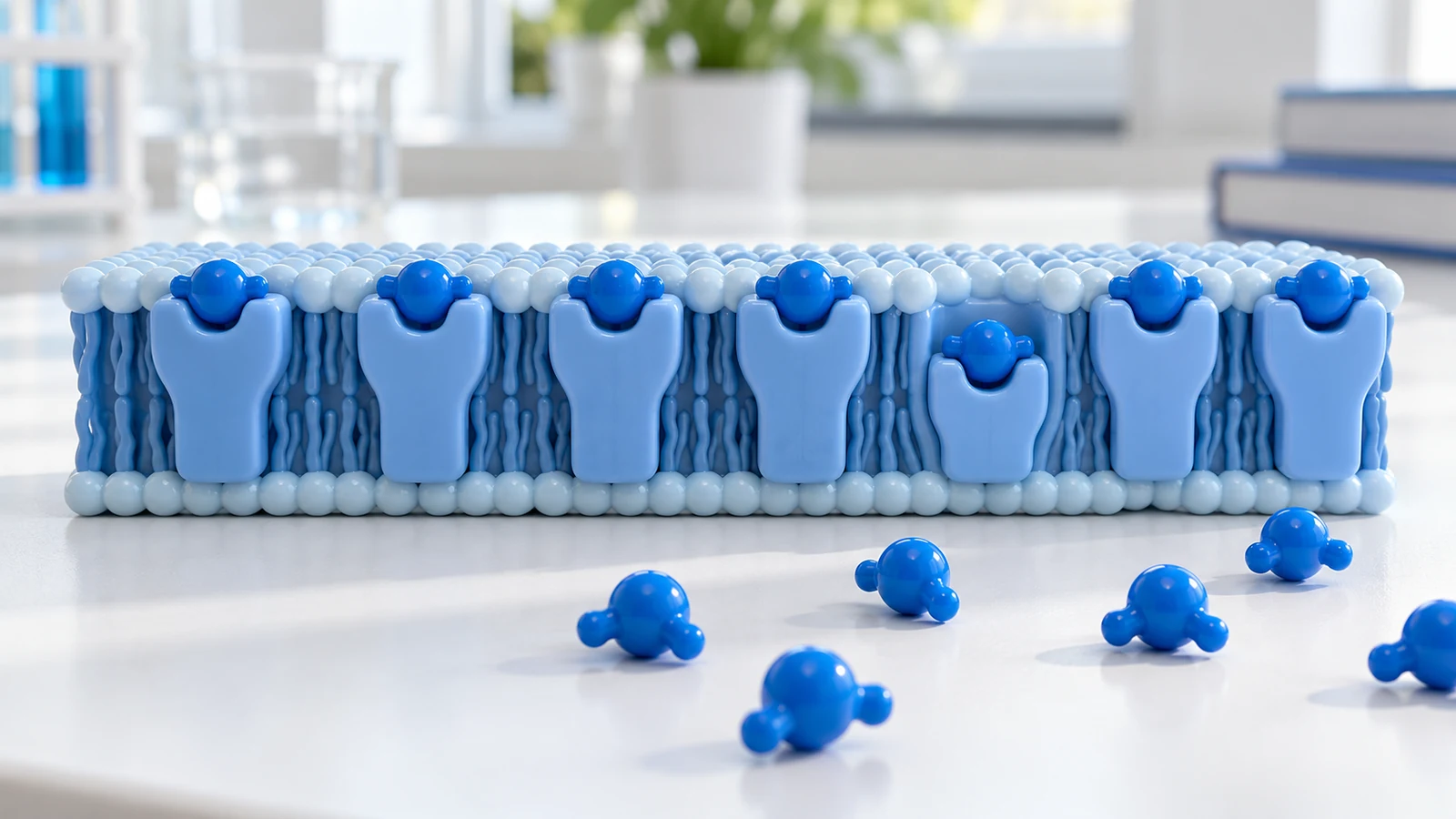
Doubling the dose does not double repair.
The limit begins with saturation. Saturation is the state where every available receptor on a cell surface is occupied by a signal molecule. Because a cell displays a finite number of receptors, it can only register so many knocks at once. Once every receptor is engaged, extra peptide in the fluid creates zero extra repair. The bottleneck moves inside the cell, which builds at its own biological speed.
Cells also defend themselves against constant stimulation through two protective processes.
Desensitization occurs when a cell uncouples a receptor from its internal machinery. Even with signal bound to the outside, the receptor stops triggering a response. The cell turns down the volume.
If high signal persists, the cell moves to internalization. Internalization is the process where a cell pulls receptors off the membrane and draws them inside. The door is removed from the wall. The cell becomes deaf to the signal until it rests, resets, and returns those receptors to the surface.
Timing also governs the response. A repair signal delivered while tissue is still in active inflammatory cleanup is the wrong conversation. The instruction conflicts with the current phase.
Blasting more signal does not accelerate healing. It saturates receptors, triggers desensitization, pulls doors off the surface, and wastes the compound.
What to Ask When the Vial Did Nothing
"Inject and heal" collapses four separate conditions into one verb:
- The signal must reach the target tissue intact.
- The target tissue must express a functional, matching receptor.
- The tissue must be in a phase ready to respond.
- The cell must have adequate energy, substrate, and mechanical load.
When a compound does nothing, people blame the vial. While unregulated quality is a real concern, failure often happens at the other links. The knock arrived, but the tissue lacked receptors, the site was in the wrong phase, or the body lacked substrate and load.
Dish data also breeds false confidence. Showing a peptide stimulates cells on plastic does not prove it heals a tendon under human mechanical strain. For several repair peptides, human clinical trials lag far behind animal data. Mechanism confidence should always stay ahead of outcome confidence. You can understand a receptor mechanism in theory while remaining cautious about human results.
Class discipline matters. Classes do not cross over. A satiety signal will not mend a tendon tear; a repair signal will not manage appetite. Using the wrong class is knocking on a door unrelated to the room you want to change.
This does not make peptides placebos or miracles. It makes them signals.
In clinician conversations, focus on the three links:
- Does this molecule have a confirmed, mapped receptor in the target human tissue?
- Is the tissue in a healing phase that can answer this instruction?
- Are substrate and mechanical load present to support the response?
Do not turn this into a dosing protocol or a self-assigned verdict. Use it to stop mistaking a quiet result for a fake compound, or a good recovery for vial carpentry.
The Knock Was Never the Carpenter
Guide 5 examines two specific repair compounds, BPC-157 and TB-500, but their potential rests entirely on the biology explained here.
A vial supplies only a signal. It cannot supply energy, amino acids, or structural alignment. The receptor translates the message; the living cell performs the construction.
A peptide is merely a knock at the door. Respect the signal, but never confuse the knock with the carpenter.
Respect the signal, but never confuse the knock with the carpenter.
Educational content only. It is not individual medical advice.