Prerequisites
The Bottom Line on Reading Food Labels
Claims like "natural," "multigrain," and "heart-healthy" are legally loose alibis designed to stop you in the aisle and bypass your judgment.
Ingredients are listed strictly by weight, heaviest first. If sugar or industrial seed oils sit in the top 3 slots, that is what you are mostly eating.
Could you find these ingredients on a local farm or in your grandmother's kitchen? If it reads like an industrial chemical patent, put it back.
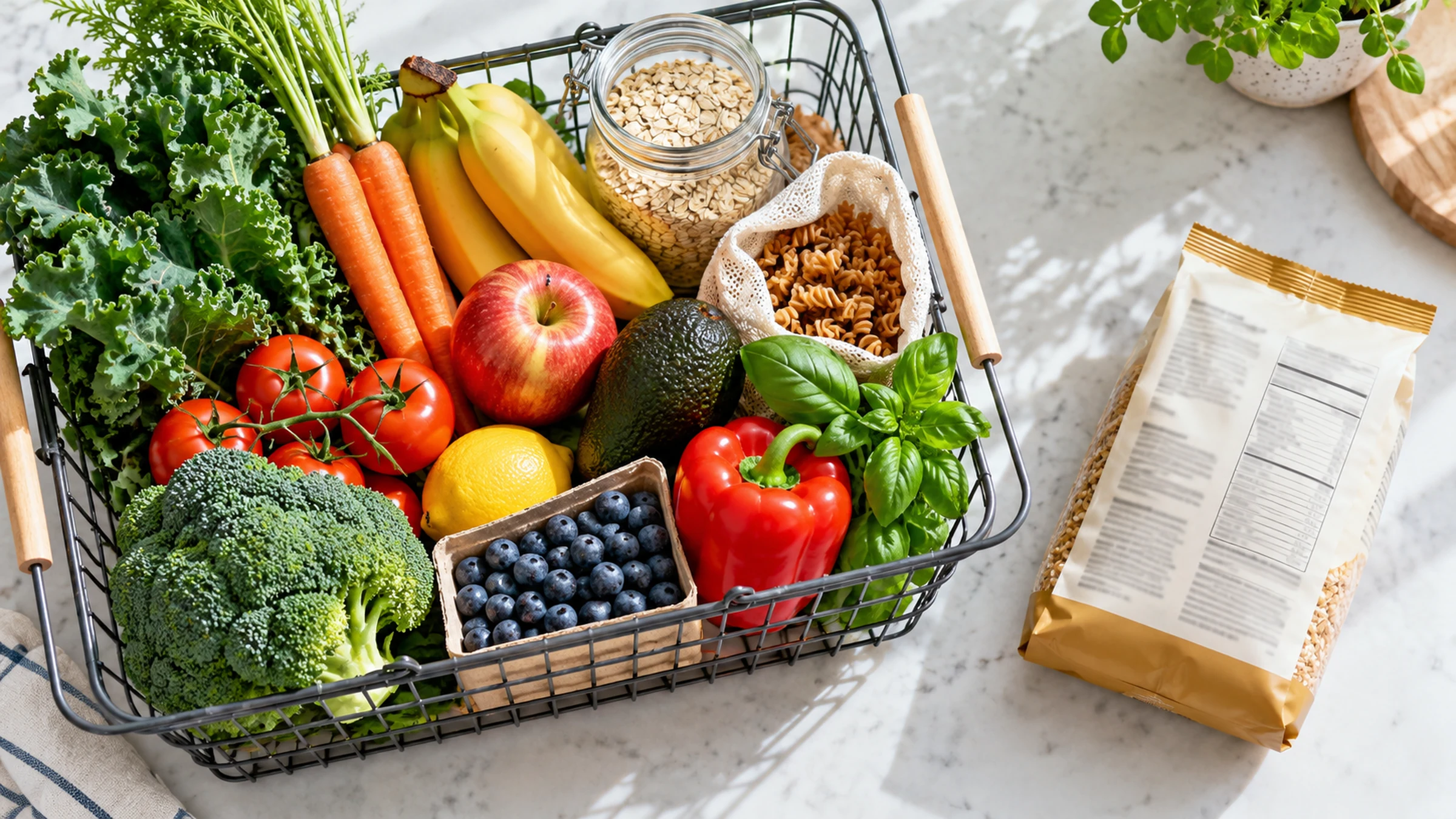
Move your plate away from Nova 4 ultra-processed hyper-palatable formulations toward Nova 1 whole, intact foods.
The Alibi and the Lineup
The front of a food package is a job interview where the product pitches its best self. Most shoppers accept this interview at face value: they spot a green banner, check a calorie count, and assume the food is nutritious. But the front of the box is an alibi. The back is the lineup under bright lights, where the ingredient list and Nutrition Facts panel disclose the legal evidence of what you are actually buying.
Your digestive tract does not process marketing claims; it processes chemical bonds, fiber networks, and fatty acids. Packaging is persuasion; molecules are what the body absorbs. Three simple checks make food quality legible in under a minute.
Packaging is persuasion; molecules are what the body absorbs.
The Front of the Box: Marketing and Health Halos
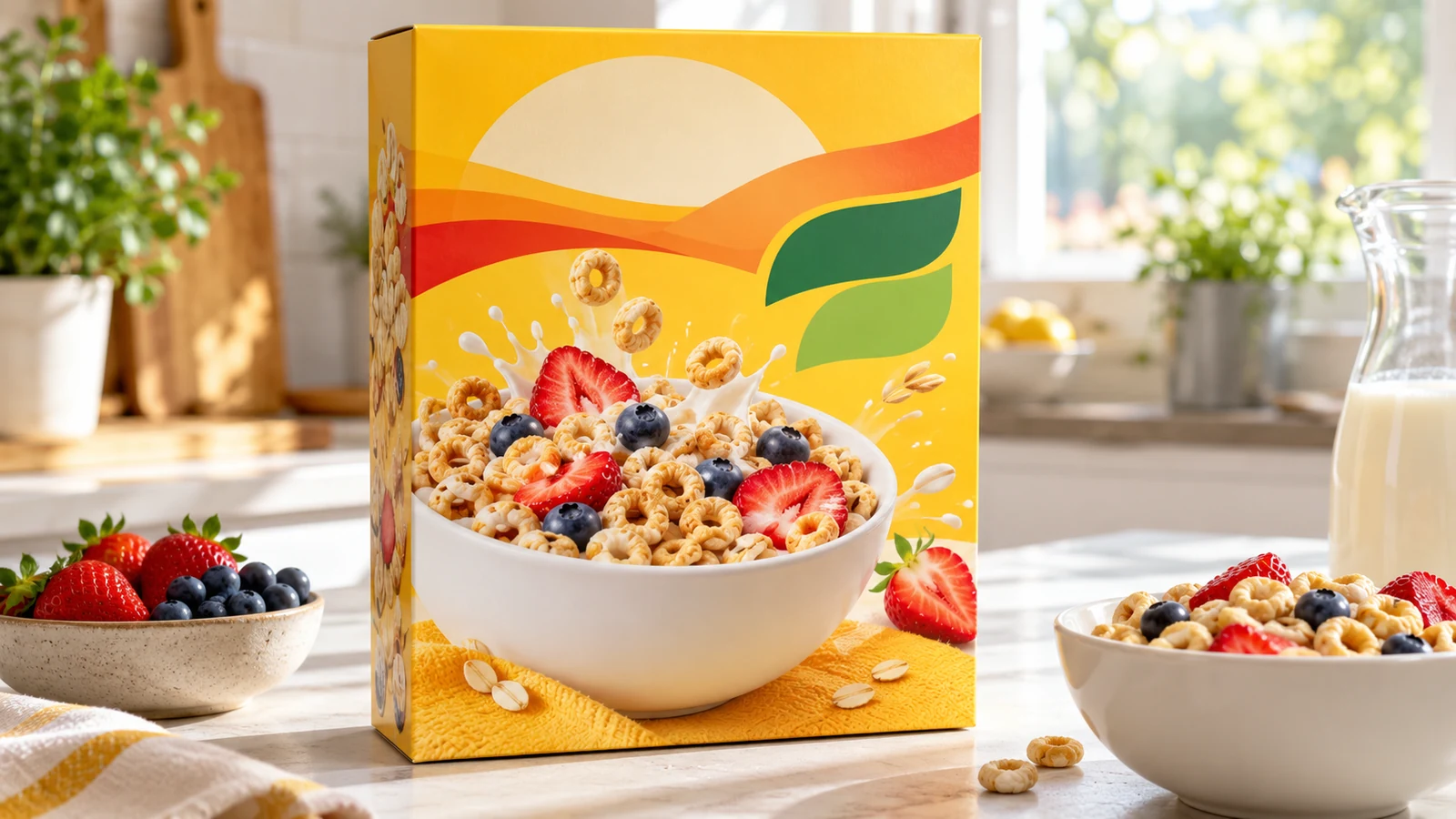
The front of the box exists to sell food, using health halos to lower your guard.
A health halo is an optical illusion in marketing where a single positive claim causes you to assume an entire product is nutritious. When a package says "organic" or "gluten-free," your brain assumes the food is wholesome, even though organic sugar is still sugar and a gluten-free cookie is still a cookie.
Front-of-package claims are governed by loose legal standards, allowing phrases that are technically defensible while functionally meaningless:
- "Natural": Largely unregulated for processed foods, guaranteeing nothing about processing, pesticide use, or sugar content.
- "Low-fat": Manufacturers routinely replace removed fat with refined starches and added sugars to restore flavor, making it a swap rather than a subtraction.
- "Made with real fruit": Legally permitted even if the food contains only a splash of juice concentrate alongside cups of syrup.
- "Multigrain": Means only that multiple grains were used, meaning five types of refined white flour qualify while digesting like white bread.
- "Immune support," "superfood," and "clean": Unregulated buzzwords with no standard legal definitions, designed to trigger an emotional purchase.
Even calories on the front act as an alibi in isolation, measuring heat energy rather than metabolic response. Two hundred calories of protein and fiber sustain fullness, while two hundred calories from a sugary drink spike blood glucose and leave you hungry thirty minutes later.
The Ingredient List: How to Read the Lineup
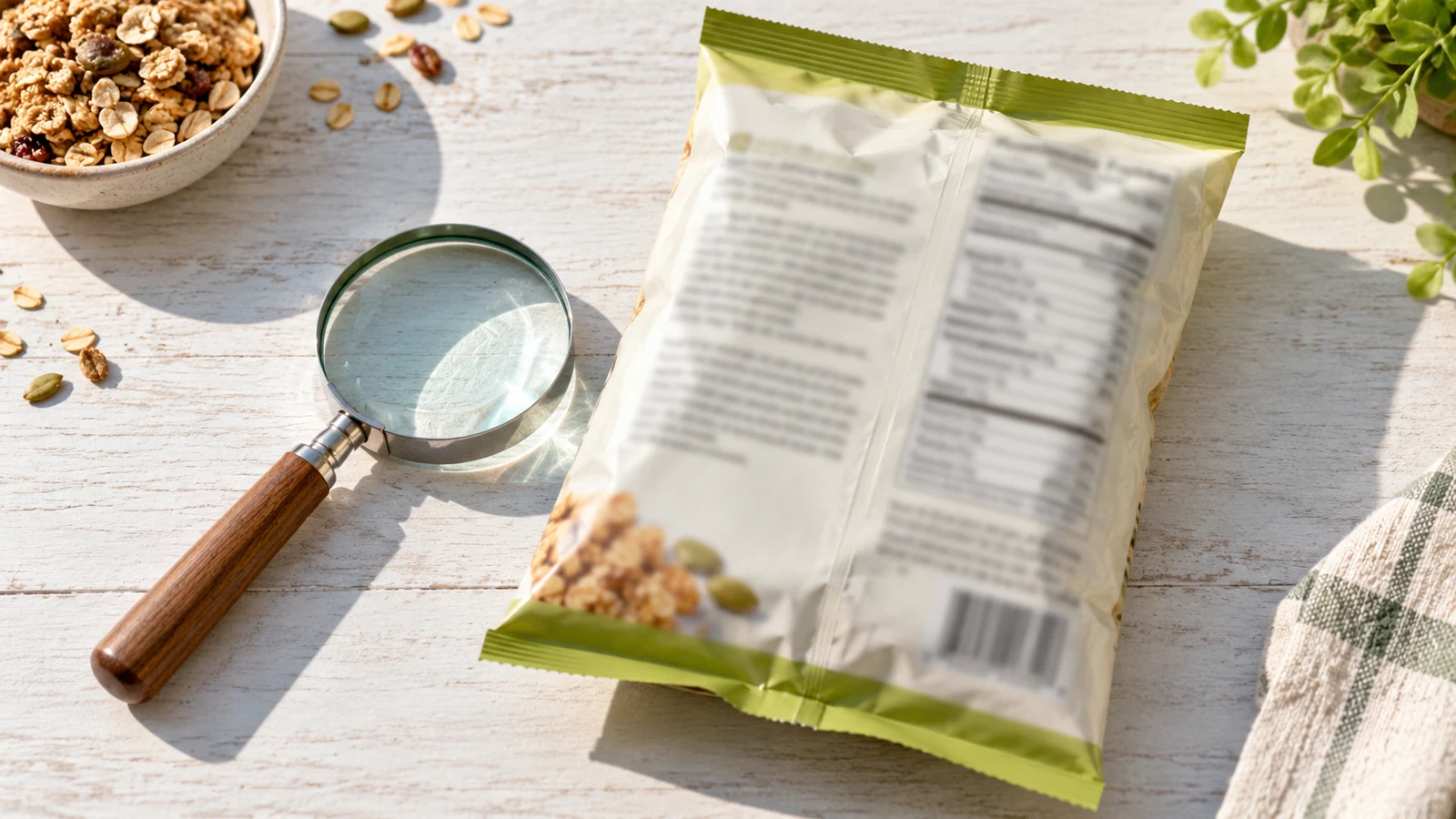
The ingredient list is where legal accountability begins.
The foundational rule is simple: order equals quantity. Food law mandates that ingredients appear in descending order by weight. Whatever weighs the most in the recipe comes first, continuing down to trace additives at the bottom. If sugar, refined flour, or vegetable oils sit in the top three slots, that is what you are mostly eating.
Apply three practical rules when reading the list:
- Check the first three to five ingredients. If whole foods like oats, chicken, beans, or tomatoes occupy these slots, the foundation is sound; if refined flours, sweeteners, and industrial oils dominate, you are holding an industrial recipe in disguise.
- Can you picture it? If the list consists of items you could find in a home kitchen (like oats, olive oil, and garlic), the food retains its matrix, but if it is an uninterrupted sequence of chemical powders, the food has been heavily altered.
- Treat length as a proxy, not a verdict. A short list usually signals minimal processing, while a long list of additives signals heavy manipulation, though wholesome recipes with many herbs or spices remain fine.
The Sugar Alias Game and Ingredient Splitting
Manufacturers disguise high sugar content using ingredient splitting: dividing total sweetener across several chemically distinct sugars so none of them weighs enough to appear near the top of the weight-ordered list. If thirty grams of sugar are divided into cane syrup, high-fructose corn syrup, maltodextrin, and fruit juice concentrate, each sweetener drops down the list behind the primary grain, masking the true sugar load.
Sugar operates under dozens of aliases: cane juice, beet sugar, brown rice syrup, corn syrup, dextrose, maltose, fructose, agave nectar, molasses, honey, and fruit juice concentrate. Your liver and bloodstream treat them with little distinction. The metabolic impact depends on total dose and absorption speed, not the marketing label.
The Processing Spectrum: A Practical Scale
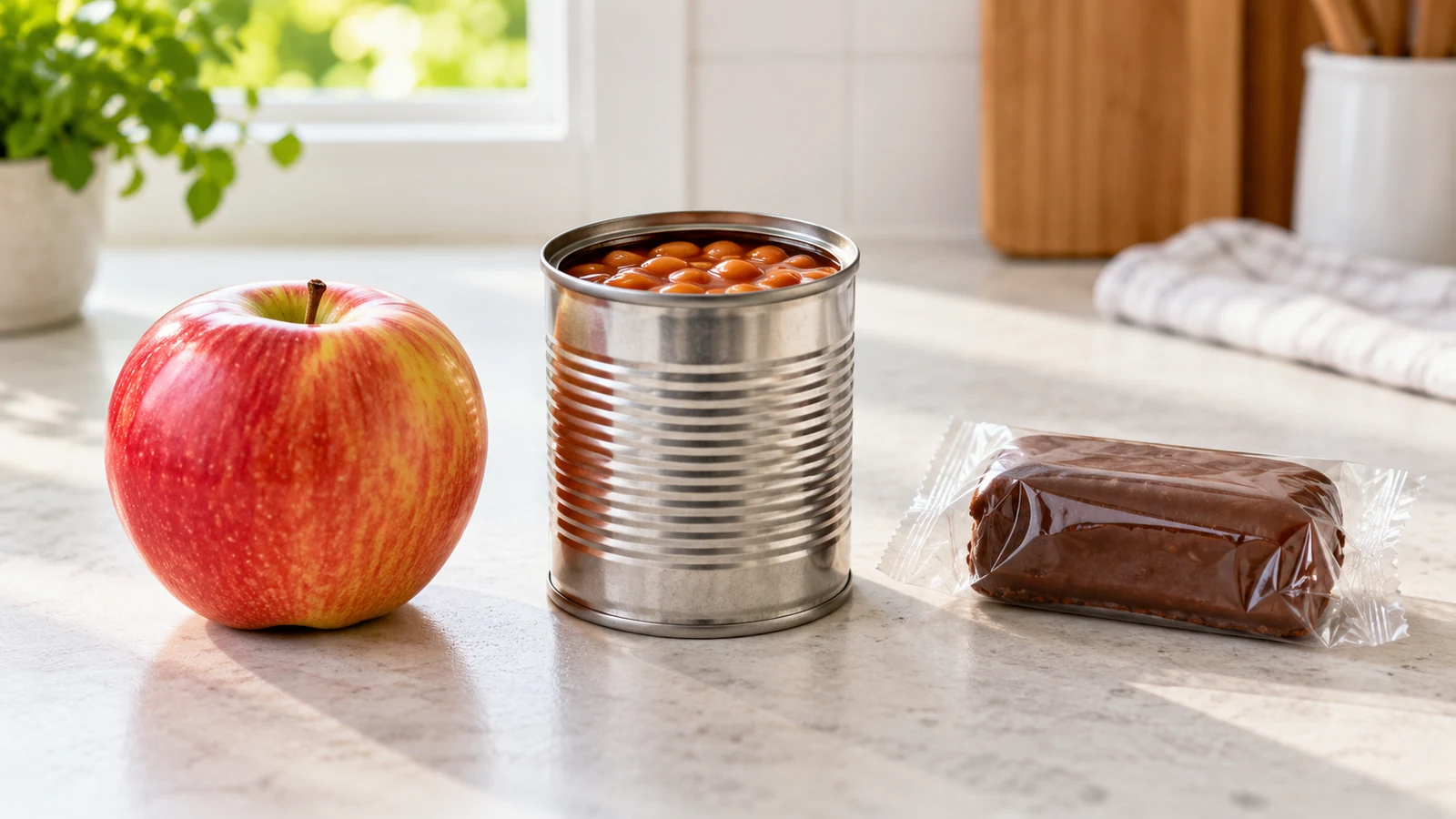
In fitness culture, "processed" is frequently treated as an insult. This is an unhelpful framework. Cooking, chopping, freezing, fermenting, and canning are all forms of processing. Freezing vegetables preserves vitamins at peak harvest, and canned beans provide high-quality fiber and protein without hours of prep. Processing is a spectrum of physical alteration, not a moral failing.
Nutrition researchers categorize this spectrum using NOVA, a four-group classification system based on the extent and purpose of industrial processing rather than nutrient counts alone.
At the far end sit ultra-processed foods: industrial formulations manufactured largely from substances extracted from whole foods (such as refined starches, isolated proteins, and industrial oils) and chemical additives, containing little to no intact food. These products routinely contain emulsifiers, which are additives that force oil and water to blend smoothly, preventing separation and creating an unnaturally creamy, shelf-stable texture.
- Unprocessed or Minimally Processed: What it means: Whole foods cleaned, cut, frozen, or dried without added substances. Everyday examples: Fresh apples, cuts of meat, eggs, rolled oats, frozen broccoli.
- Processed Culinary Ingredients: What it means: Substances extracted from nature to cook, season, and prepare meals. Everyday examples: Olive oil, butter, vinegar, honey, table salt.
- Processed Foods: What it means: Whole foods combined with culinary ingredients to preserve them or improve taste. Everyday examples: Canned black beans, canned tuna, salted almonds, bakery bread, aged cheese.
- Ultra-Processed Foods: What it means: Industrial formulations assembled from refined extracts, flavorings, and emulsifiers. Everyday examples: Soft drinks, packaged snack cakes, mass-market hot dogs, chips.
The danger of ultra-processed food is structural rather than toxic. These foods hit an engineered combination of fat, sugar, and salt that does not exist in nature. Being soft and energy-dense, they require minimal chewing and bypass natural satiety signals, making it easy to consume excess energy without feeling full.
Key idea
The goal is not monastic purity. A sustainable kitchen uses culinary ingredients and convenient staples every day. The objective is simply to keep your diet anchored in the first three categories, preventing ultra-processed formulations from becoming your default.
The 4-Stage NOVA Classification System
Evaluating food quality by structural integrity and degree of industrial alteration
Unprocessed & Minimally Processed
Intact biological tissue. Cellular walls, natural fiber meshes, and micronutrient complexes intact.
Processed Culinary Ingredients
Substances extracted from nature to prepare meals. Used in seasoning, roasting, and traditional cooking.
Processed Foods
Simple combinations of Group 1 and Group 2 created to extend shelf life or enhance traditional flavor.
Ultra-Processed Foods (UPF)
Deconstructed food substances assembled with emulsifiers, artificial flavors, and hyper-palatable fat/sugar ratios designed to bypass biological satiety.
The Nutrition Facts Panel: What to Check and What to Skip
Once you have reviewed the ingredient list, glance at the Nutrition Facts panel to see how much of each component the food delivers. Focus on four items, in order:
- Serving Size: Read this first because every number below is calibrated to it. If a bottle of sweetened tea lists ninety calories but defines a serving as half the bottle, drinking the container doubles every value.
- Protein and Fiber: Check the absolute grams. Protein and fiber are what slow digestion and hold fullness in place, whereas a snack high in refined carbohydrates with zero fiber breaks down into glucose almost immediately.
- Added Sugar versus Total Sugar: Total sugar includes naturally occurring sugars within whole foods, like lactose in milk or fructose in fruit, while added sugar refers to caloric sweeteners introduced during manufacturing. Plain yogurt displays natural lactose but zero added sugar, while flavored yogurt can pack fifteen grams of added syrup; keep added sugar as low as possible.
- Type of Fat: Note the balance of saturated and unsaturated fats, and cross-reference with the ingredients. Fat from olive oil or nuts delivers cellular building blocks, while fat from partially hydrogenated oils carries trans fat, which is the one fat type with no safe intake level.
What to skip:
- Calorie counts in isolation, which tell you nothing about satiety or food quality.
- Synthetic micronutrient percentages, which reflect powder sprayed onto starch rather than whole-food nutrition.
- Marketing slogans on the panel, which are advertising rather than legal disclosures.
The Dissected Forensic Nutrition Label
How industrial formulation exploits FDA rounding rules and naming loopholes
The front label reads "110 Calories", but the package contains 2.5 servings. Consuming the actual container delivers 275 calories and 35g of added sugar.
FDA regulations permit any value under 0.5g per serving to be rounded down to "0g". The ingredient list confirms "Partially Hydrogenated Soybean Oil" — toxic artificial trans fat is present.
Manufacturers split sugar into high-fructose corn syrup, maltodextrin, and cane syrup so each individual sugar appears lower on the mandatory descending weight order.
Phrases like "Made with Real Fruit", "Gluten-Free", or "Heart Healthy" are marketing claims with zero correlation to metabolic satiety or cellular nourishment.
Three Questions in the Grocery Aisle
You do not need an app, a barcode reader, or a list of forbidden chemicals. To evaluate food quality in thirty seconds, ask three questions in order:
- What are the first three ingredients? Skip the marketing on the front and check what the food is actually made of.
- Where does this fall on the processing spectrum? Determine whether it is an intact whole food, a useful processed staple, or an ultra-processed formulation.
- What useful nutrients does it deliver? Look for meaningful grams of protein, fiber, or quality fats rather than empty calories.
Food is not a moral test; it is biological information your body must process. When you inspect the evidence instead of buying the sales pitch, you take command of what you feed yourself.
Educational content only. It is not individual medical advice.