
Prerequisites
The Bottom Line on Blood Sugar & Insulin
Blood glucose is a concentration your brain defends aggressively. Too low and you brown out; too high and delicate vessels take microvascular damage.
Insulin doesn't shovel glucose itself; it knocks on cell doors (GLUT4 transporters) so muscles and liver clear cargo off the roadway.
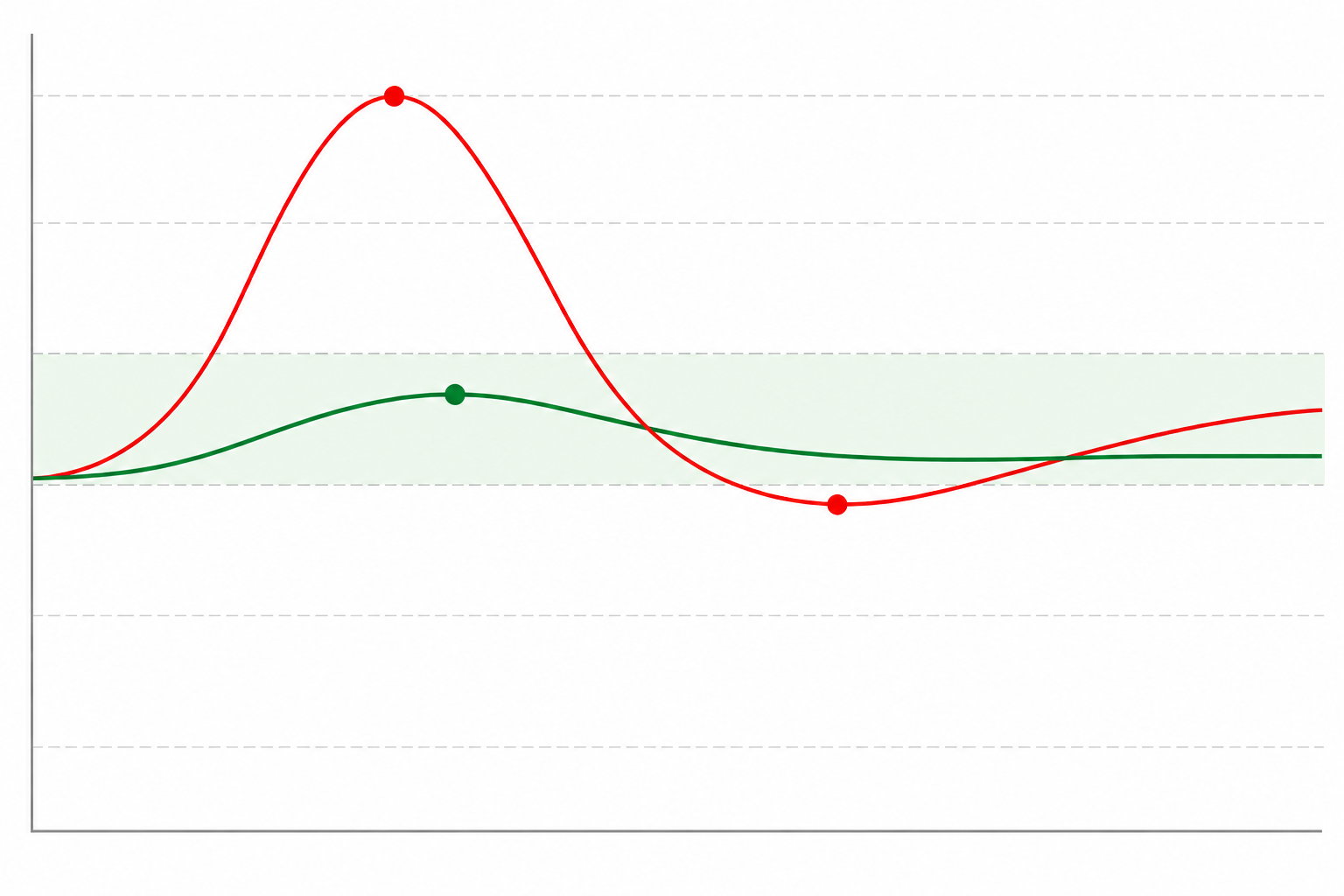
A rapid sugar spike forces an aggressive insulin surge that clears glucose too fast, plunging you below baseline into the 3:00 PM exhaustion slump.
Insulin manages the incoming fed shift (clearing trucks); glucagon manages the between-meal fasted shift (releasing stored liver glucose for brain fuel).
The Brain's Water Line
Your body treats blood sugar like a water line in a municipal system. The brain requires a continuous delivery of fuel to stay functional, but delicate blood vessels cannot tolerate high concentrations of sugar without sustaining physical damage. Because of these competing demands, your physiology defends a narrow band of circulating fuel with relentless precision. The regulatory system that manages this balance is active on every meal you eat.
Blood glucose is the concentration of simple sugar dissolved in your bloodstream at any given moment. Glucose is a basic carbohydrate that your digestive tract extracts from food, serving as the fastest fuel for human cells. Your brain consumes roughly twenty percent of your daily energy while lacking the capacity to store fuel for later. It depends on a steady stream of glucose arriving through the blood every second of the day.
Your body defends this concentration within a strict range. In a resting adult with normal blood volume, roughly four grams of glucose is dissolved across all five liters of blood, about a single level teaspoon. If that concentration drops significantly below normal, your brain starves for fuel. You experience tremors, cold sweat, visual blurring, confusion, and an urgent, survival-driven demand to eat.
Allowing blood glucose to stay elevated causes its own progressive damage. When sugar concentrations remain high, circulating glucose molecules bind haphazardly to structural proteins, stiffening and inflaming blood vessel walls. The smallest, most fragile capillaries suffer first, specifically those supplying the retinas of your eyes, the filtering units of your kidneys, and the nerves in your extremities. The body treats elevated circulating sugar as an urgent sorting problem that must be resolved before tissues take structural wear.
The water line metaphor helps visualize this defended target, but the image has a clear limit. Your bloodstream is not a stagnant reservoir sitting behind a dam. It is an active, pressurized circuit where organs continuously draw fuel out and meals push new fuel in at irregular intervals. Defending the line is not a matter of reading a passive float valve; it requires constant, active chemical signaling.
Insulin as the Dispatcher

Insulin is the primary signaling hormone that manages incoming fuel. Produced and stored by specialized beta cells in your pancreas, insulin releases into the bloodstream whenever circulating glucose begins to rise after a meal. It does not burn sugar itself, nor does it physically drag sugar out of the blood. It operates as an informational dispatcher, moving through circulation and delivering a clear command to your tissues: open your doors, clear the roadway, and take in cargo.
At the cellular level, this dispatching process works through physical receptors. Muscle and fat cells keep their glucose transport doorways tucked away inside the cell when fuel is not arriving. When insulin lands on the cell surface and binds to its receptor, it triggers an internal signal that causes these transport doorways, known as GLUT4 proteins, to travel to the outer cell membrane. The doorways fuse with the cell surface, creating open channels through which glucose flows out of the blood and into the cell. This depot metaphor illustrates how logistics work, but its limit is physical: insulin is purely the work order, and it cannot force a damaged or overloaded cell to accept cargo if the internal machinery will not respond.
Once inside a cell, incoming glucose that is not burned immediately for energy is converted into glycogen. Glycogen is a dense, branched storage molecule made of thousands of glucose units linked together in a compact chain. Storing excess sugar as glycogen allows tissues to pack away substantial energy reserves without drawing excess water into cells or disturbing blood chemistry.
When insulin directs incoming glucose off the bloodstream highway, it routes the cargo into three specific destinations based on immediate need and storage capacity.
- Immediate Fuel: Target tissue: Active cells. Storage form: Burned on arrival. Metabolic role: Powers current movement, brain work, and cellular repair.
- Fast Reserves: Target tissue: Muscle and liver. Storage form: Packed glycogen. Metabolic role: Muscle fuels its own contraction; liver steadies the blood.
- Overflow Reserves: Target tissue: Fat tissue. Storage form: Stored triglycerides. Metabolic role: Long-term energy storage once glycogen reserves are full.
The body fills these storage destinations in a strict order of priority. Active cells first burn whatever glucose they need to satisfy immediate energy demands. Next, insulin directs excess glucose into the glycogen reserves of your skeletal muscles and liver. Muscle tissue holds the vast majority of this reserve to fuel physical work, while the liver holds a smaller cache dedicated to stabilizing blood sugar between meals. Only when these glycogen pantries are completely full does the body convert remaining surplus glucose into triglycerides for long-term storage in fat tissue.
The 3 Doors of Insulin Disposal
Where incoming circulating glucose is routed once cleared from the bloodstream
Skeletal Muscle
Capacity: ~400–500g GlycogenThe largest glucose sink in the human body. Contraction and insulin translocate GLUT4 vesicles to pull glucose into myocytes for athletic work and recovery.
Hepatic Liver Vault
Capacity: ~90–120g GlycogenThe central metabolic governor. Regulates systemic euglycemia overnight and during exercise, releasing precise glucose aliquots via glycogenolysis.
Adipose Tissue (Fat)
Capacity: Virtually UnlimitedWhen muscle and liver glycogen tanks are fully saturated, excess glucose undergoes De Novo Lipogenesis (DNL), converting into triglycerides for long-term storage.
Glucagon and the Opposite Shift
Between meals, your body runs an opposite shift managed by a counter-regulatory hormone called glucagon. Glucagon is a peptide hormone produced by alpha cells in your pancreas, and it enters the bloodstream when circulating glucose begins to dip several hours after eating. While insulin manages the fed shift when new fuel is arriving, glucagon manages the fasted shift when fuel must be drawn out of storage.
Glucagon travels directly to the liver and issues the reverse instruction of insulin. It instructs liver cells to dismantle their stored glycogen chains back into individual glucose molecules and release them into the bloodstream. This constant, metered release of glucose prevents your blood sugar from falling into a basement while you sleep or work between meals. Insulin and glucagon are not rivals fighting for dominance; they are complementary shift workers ensuring that the brain's water line remains stable twenty-four hours a day.
Insulin and glucagon are not rivals fighting for dominance; they are complementary shift workers ensuring that the brain's water line remains stable twenty-four hours a day.
The Daily Wave: Spike, Overshoot, and Crash

The shape of your blood sugar wave over the course of a day depends on how rapidly your meals deliver glucose into the bloodstream. A meal that digests slowly creates a gentle, rolling rise in blood sugar that returns smoothly to baseline. A meal that dumps sugar into the gut all at once produces a jagged spike followed by a steep hormonal reaction.
Fast-digesting carbohydrates, including sugary drinks, candy, and refined white flour, break down almost immediately in the digestive tract. Millions of glucose molecules flood across the intestinal wall into circulation in a matter of minutes. This rapid arrival creates a steep, vertical spike in blood sugar that threatens the integrity of delicate blood vessels.
Confronted with an abrupt flood of sugar, the pancreas releases an equally rapid surge of insulin. Because this hormonal surge arrives so quickly and in such high concentration, cells clear glucose out of the blood so aggressively that circulating fuel plunges below your starting baseline before your digestive system can replenish it.
This overshoot leads directly to an energy crash and a craving cycle. As blood sugar drops rapidly into this deficit, your brain perceives the steep downward trajectory as an acute fuel shortage. Your body releases stress hormones like adrenaline and cortisol to force emergency sugar back into circulation. You experience brain fog, a drop in physical energy, irritability, and a powerful biological drive to consume fast-acting carbohydrates. If you reach for another sugary snack or refined starch to relieve the symptoms, you launch another steep spike, locking yourself into a continuous cycle of surges and crashes throughout the day.
Continuous Glucose Waveform Analysis
140
100
60
How Meal Packaging Changes the Curve

The structural packaging of your food determines whether a meal acts like kindling or a slow-burning log. The three primary stabilizers that reshape the glucose wave are dietary fiber, protein, and fat.
Dietary fiber acts as a physical brake inside the digestive tract. Soluble fiber absorbs water and forms a thick, viscous gel within the small intestine. This gel mesh physically traps starch and sugar molecules, slowing the rate at which digestive enzymes can break them down and transport them across the gut barrier. Because the glucose trickles into the bloodstream gradually, the pancreas responds with a modest, controlled release of insulin that prevents an overshoot.
Dietary protein and fat stabilize blood sugar by slowing down gastric emptying, the rate at which the stomach releases its contents into the small intestine. When a meal contains meaningful amounts of protein and fat alongside carbohydrates, food remains in the stomach longer, undergoing thorough mechanical and chemical breakdown. The small intestine receives carbohydrate in measured batches rather than an overwhelming flood, flattening the post-meal glucose curve.
Liquid sugars represent the extreme opposite of a packaged meal. When you drink sugar dissolved in water, coffee, or juice, the liquid bypasses the stomach's mechanical digestion entirely and empties into the small intestine within minutes. There is no fiber matrix, no protein structure, and no fat to slow absorption. Whole fruit provides water and sugar wrapped in an intact cell wall matrix of fiber; fruit juice discards that protective architecture, turning a slow-burning food into an immediate metabolic shock.
When the Knock Stops Getting Answered
How your body handles these waves over decades determines your degree of insulin sensitivity. Insulin sensitivity describes how readily your cells respond to a normal, quiet knock from the dispatcher. In an insulin-sensitive person, target tissues possess abundant, responsive receptors; a tiny pulse of insulin swings open enough doorways to clear incoming glucose quickly and quietly.
Insulin resistance develops when cells are subjected to relentless, high-volume knocks without recovery. When a chronic energy surplus combined with little physical movement keeps insulin traffic high for years, target cells protect themselves from fuel overload by down-regulating their receptors. They become partially deaf to the signal. The dispatcher knocks, but the cell doors open sluggishly or not at all.
In response to this resistance, the pancreas does not give up; it simply shouts louder. It produces several times more insulin to force the same clearance. For years or even decades, a person's routine fasting blood sugar numbers may appear completely normal on standard laboratory tests because the pancreas is running on maximum overdrive to keep the roadway clear. What the person feels during this prolonged phase is not a lab abnormal, but persistent fatigue, unstable daytime energy, and hunger that returns too quickly after eating.
Key idea
Physical movement provides an essential bypass around this signaling bottleneck. When skeletal muscles contract during walking, weight lifting, or manual labor, they activate an internal pathway that moves glucose transport doorways to the cell membrane completely independent of insulin. Muscle contractions pull glucose out of the blood without requiring the pancreas to produce more hormone. Regular physical activity restores metabolic breathing room by clearing fuel through physical demand rather than hormonal force.
What to Notice at Your Next Meal
You do not need specialized sensors or medical devices to observe this machinery at work. You can evaluate the stability of your daily glucose wave simply by noticing how your body feels between one and three hours after eating your next meal.
A steep spike and crash reveals itself through distinct physical signals. If a meal leaves you battling heavy eyelids, reaching for another cup of coffee, feeling mentally scattered, or rummaging through the kitchen two hours after eating, your meal lacked structural packaging. The carbohydrate arrived too fast, the dispatcher cleared the flood aggressively, and your blood sugar plummeted into a post-meal valley.
A stable glucose wave produces sustained, calm vitality. When you anchor carbohydrates with adequate fiber, protein, and fat, glucose enters in a measured stream. Your physical energy stays level, your focus remains clear, and your appetite stays quiet for four to five hours because your brain receives a constant, uninterrupted flow of fuel.
Your blood sugar wave is not a reflection of willpower or moral discipline. It is the direct physiological output of how quickly your food delivers fuel to the dispatcher. By understanding how the depot works, you can construct meals that keep the roadway calm, the warehouses receptive, and your daily energy steady.
Educational content only. It is not individual medical advice.