Metabolic Health · Gut & Inflammation
The Gut Protocol I Use to Calm Inflammation and Support Recovery
Five tools. One problem: a gut lining that is letting too much through.
A patient sat across from me recently and laid a two-inch folder of medical records on the desk.
She had spent four years moving from one specialist to the next as her health unraveled. Each visit focused on a different symptom. None of them connected the dots.
By the time she reached my office, she was managing a rotation of five distinct providers:
- 01 The Dermatologist: Strong steroid cream for stubborn eczema patches on her forearms and neck.
- 02 The Gastroenterologist: Daily acid-reducing medication for throat reflux and persistent bloating.
- 03 The Rheumatologist: Daily anti-inflammatory pain medication and a possible immune-targeting drug for joint stiffness and morning swelling.
- 04 The Endocrinologist: Annual blood tests tracking thyroid antibodies, with instructions to wait until the gland declined further.
- 05 The Allergist/Dietitian: A food panel flagging 24 foods, leaving her anxious and stuck with six "safe" meals.
She looked at me and asked the only question that mattered: "How did my body fall apart in five different places all at the same time?"
I gave her the bigger picture that none of those five waiting rooms had stopped to explain:
You may not have five unrelated problems. You may have one gut barrier problem showing up in five different places.
Your skin, thyroid, joints, brain, and metabolism do not operate in separate rooms.
When the gut's security gate gets too loose, material from inside the gut can cross into the bloodstream. The immune system stays switched on, and your most vulnerable tissues feel the fallout.
The Main Water Line: Why Treating Symptoms Separately Misses the Point
Picture the plumbing in a house.
If dirty water leaks into the main pipe entering a house, every room can show a different symptom.
The kitchen sink comes out brown. The bathroom shower smells like sulfur. The garden hose starts killing the grass.
What would you think of a plumber who polished the kitchen faucet, replaced the shower head, and treated the dying lawn without checking the main water line?
You would tell them to check the source.
A similar pattern can happen when chronic inflammation is treated one symptom at a time:
- The skin flare goes to dermatology.
- The joint pain goes to rheumatology or orthopedics.
- The thyroid antibodies go to endocrinology.
- The brain fog and fatigue get labeled "stress and aging."
Each person looks at one faucet. Nobody checks the main pipe.
A large share of your immune system sits around the gut lining. When that lining loses strength, the problem does not always stay in your stomach. Inflammatory signals can travel, and your most vulnerable tissues feel the pressure first.
How a Leaky Gut Can Affect the Rest of the Body
Your digestive tract is a tube that runs through your body. Its lining separates food, bacteria, and waste from your bloodstream.
The cells in that lining are held together by tiny seals called tight junctions.
When the barrier is healthy, digested nutrients can pass through while larger particles stay in the gut and leave through your stool.
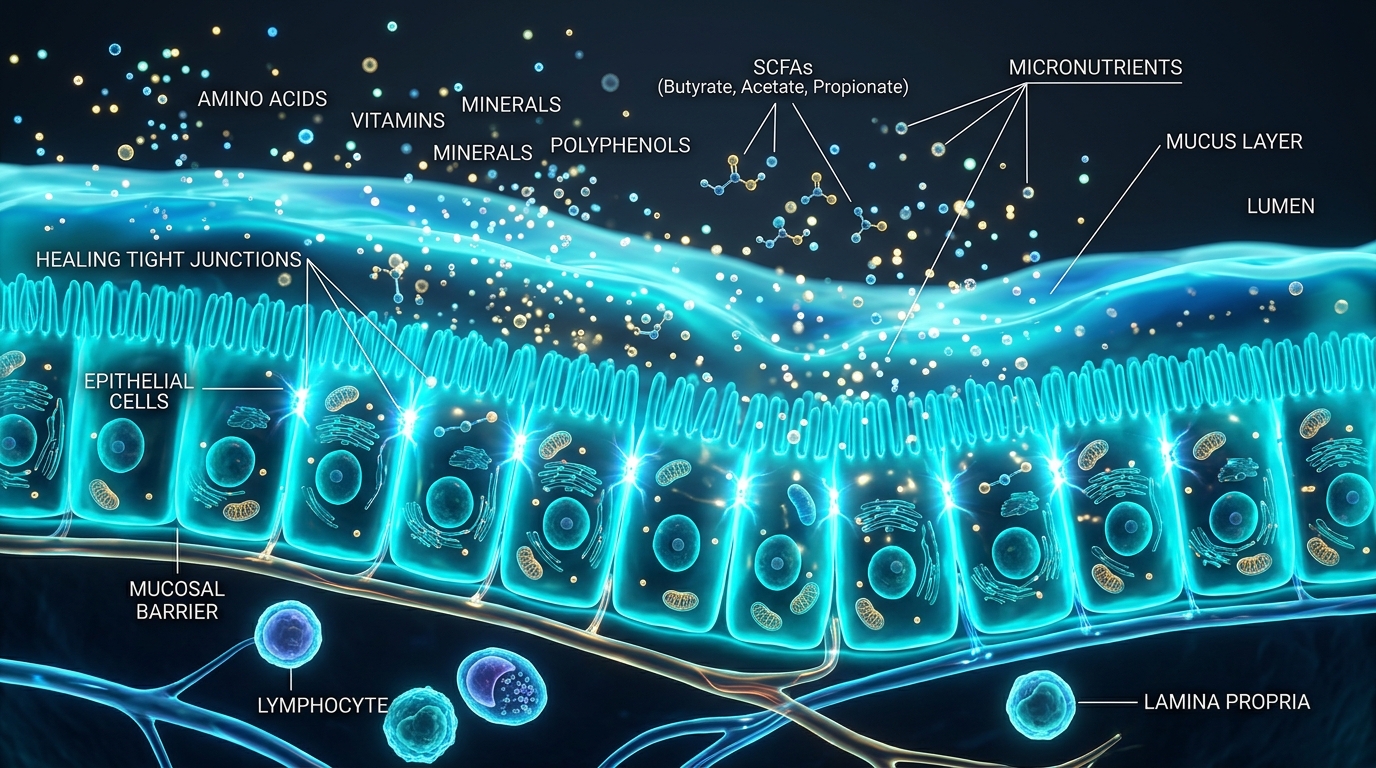
The 4 Steps from Gut Irritation to Whole-Body Inflammation
When the gut barrier loses some of its strength, the pattern can look like this:
Stress, some medicines, and an imbalanced gut can weaken the seals between gut-lining cells.
Weaker gut barrierBacterial byproducts such as LPS can move from the gut into nearby blood vessels.
More bacterial byproductsWhite blood cells see those byproducts and release inflammatory signals.
Inflammation risesThose signals can affect the thyroid, joints, brain, or skin—depending on your weak spots.
Symptoms flareWhy Symptoms Show Up in Different Places
Once inflammatory signals enter circulation, they can irritate the areas already under the most strain:
- The Thyroid: Some food and bacterial fragments can resemble body tissue closely enough to confuse immune defenses. In Hashimoto’s, that can add to thyroid inflammation.
- The Brain: Inflammatory signals can activate immune cells in the brain. That can feel like brain fog, poor memory, unrefreshing sleep, and fatigue.
- The Joints: Inflammation can make pain nerves more sensitive and muscles guard a joint. Treatment may feel good for a day or two, then stiffness returns. Read why pain keeps coming back.
- The Skin: Inflammation can show up as histamine symptoms, eczema, psoriasis, or rosacea.
Why Common Gut Fixes Don’t Hold
Most patients arrive after trying the usual gut-health fixes. That does not mean they lacked willpower. Most of these approaches simply leave out part of the biology.
Many supermarket probiotics are fragile. Stomach acid can kill a large share before they reach the intestine, and the wrong product can leave some people with more gas and bloating.
Charcoal can bind more than toxins. It may also interfere with medicines and nutrients, and it can worsen constipation.
Removing foods can lower symptoms for a while. But living on six “safe” foods can leave you short on fiber and make your diet harder to sustain.
Strong antimicrobials can hit helpful bacteria along with unwanted organisms. That can leave the gut less resilient and give yeast room to come back.
Juicing strips out much of the fiber while concentrating sugar. You lose the part of the plant that feeds the gut while getting a faster sugar load.
A normal CBC and CMP can be reassuring, but they do not measure every kind of gut-barrier or low-grade inflammatory problem.
The 5-Compound Gut Protocol
The sequence uses five tools, each with a different job: support the gut, break down biofilm, target yeast, bind bacterial byproducts, and protect the gut lining.
Spore-Based Probiotics
Many standard probiotics are fragile. Spore-based Bacillus strains have a protective shell that helps them survive the trip through the stomach. Once they reach the intestine, they can support the bacteria that make butyrate, a fuel source for the gut lining.
Biofilm Enzymes
Some unwanted bacteria and yeast protect themselves with a sticky layer called a biofilm. Candifense is taken away from food so its enzymes can work on that layer instead of on your meal.
Caprylic Acid
After the protective layer is disrupted, caprylic acid is used to target Candida yeast. The goal is to target yeast while preserving the rest of the gut ecosystem.
Serum-Derived Bovine Immunoglobulins (SBI)
When unwanted microbes break down, they can release LPS, a bacterial byproduct, into the gut. SBI is used to bind some of those byproducts so they can leave the body through your stool. Some people notice headaches, brain fog, fatigue, or joint flares as the plan gets started.
Saccharomyces boulardii (Probiotic Yeast)
S. boulardii is a temporary probiotic yeast. It does not permanently live in the gut. It helps compete with Candida for space and supports the gut's local immune defenses.
Your 3-Window Daily Schedule
You do not need a complicated timer or a notebook full of reminders. Use three clear daily checkpoints and keep the routine simple.
Your 3-Window Daily Schedule
A symptom spike is not proof the protocol is "working". It may mean the plan is moving faster than your body can handle right now.
2. Slow the Spore Probiotic: Step down to 1/2 capsule for 4–5 days.
3. Hydrate consistently: Minimum 3 liters of water with trace electrolytes daily.
Your 90-Day Gut-Lining Roadmap
Your gut did not get irritated in a week. Stress, poor fuel, medications, and years of accumulated strain can add up over time.
Your gut lining can renew quickly, but the wider inflammation pattern takes longer to settle. Think in 90-day blocks, not overnight results.
Candifense and the binder do their jobs away from food. The goal is to reduce the burden on the gut and make the plan easier to tolerate.
Spore-based probiotics and food support the bacteria that make butyrate. The goal is steadier digestion and fewer food-related flares.
As the gut settles, the goal is to reduce recurring inflammation and help your body tolerate food, movement, and daily life better.
Questions Patients Ask
“Do I need a stool panel first?”
Not automatically. A stool test can show useful information, but it is only a snapshot of that day. If a gut problem keeps coming back, the question is not only “what showed up today?” It is also whether the gut environment is strong enough to stop the cycle.
“Can’t I just take L-glutamine?”
It can be useful, but it is not the whole plan. If the gut is irritated and unwanted microbes are still part of the picture, adding one powder will not fix the foundation. Support the gut environment first, then decide what else fits.
“I already take a high-CFU probiotic.”
Check the label, but do not get distracted by the biggest number on the bottle. More CFUs does not automatically mean a better product. The strain, delivery system, and how you respond matter more than the marketing number.
“Why not just use oregano oil or berberine?”
They can be useful tools in some short-term plans, but broad antimicrobials can affect helpful bacteria too. The point is to use the narrowest tool that fits the problem.
“My routine labs are normal. Why do I still feel bad?”
Normal routine labs are useful, but they do not answer every gut question. A CBC and CMP can look normal while you still have digestive symptoms or low-grade inflammation. Normal labs do not mean “nothing is happening.” They mean those tests did not find an acute crisis.
Your Whole-Body Plan
I publish the compounds, dosing, and timing so you can see how the pieces fit. Use this as a map—not a reason to copy a protocol blindly.
When symptoms have been building for years, when multiple markers are changing, or when fatigue and stiffness keep stacking up, the gut work belongs inside a bigger plan.
- The Gut Foundation: Supporting the gut lining and binding bacterial byproducts.
- The Metabolic Baseline: Steadying blood sugar so it stops adding fuel to inflammation. Read why your labs can look normal while the immune system is in overdrive.
- The Structural Frame: Restoring joint motion and rebuilding physical capacity so movement can hold. See the method.
Stop treating every symptom as a separate mystery.
Start with the main water line. Find the leak. Then build the rest of the system around it.